
Bitcoin full node and query server
March 2020
Archive of the libbitcoin Slack #general channel.
Sunday, March 1, 2020

vdeurzen23:46
In an effort to get something running while my node syncs I'm connecting with the ZMQ client (following the examples). I have everything compiling, however, interestingly I'm getting the same transaction all the time when connected to the transaction_publishing port mentioned here: https://github.com/libbitcoin/libbitcoin-server/wiki/Community-Servers
I followed this example: https://github.com/libbitcoin/libbitcoin-server/wiki/Transaction-Service
Any idea what I might be doing wrong?
I'm using v4 of the libraries
Monday, March 2, 2020
vdeurzen14:20
The block subscription on testnet seems to stall from time to time, I've not received a new block even though there are 2 new since the last one I've received. Anything I can do about that?
4 replies · neillm, vdeurzen · last Mar 03, 2020

neillm19:48
They do have to be renewed, and sometimes in less time than you think since the server can drop you with its timeout before your client's.
vdeurzen21:25
I mostly copied the zmq example for the block subscription service, is there a different way I should use it?
Tuesday, March 3, 2020
vdeurzen14:36
Are the stored database formats between v3 and v4 compatible? I'm wondering if I can use an old back-up to get my node up-to-date a bit quicker
Any ideas for the zmq subscription? I essentially want to get blocks and transactions, as long as my node is still syncing
^ two different set-ups of course, but I would like to get some data in so I can get the rest of my services working while I wait for the sync to finish 🙂
vdeurzen15:07
I'm looking to push the latest blocks and transactions into another service, don't really have a need for older blocks or transactions
vdeurzen15:08
it's just a passive view on the latest events in the blockchain, I only care that I'm not sending invalid blocks or following a completely wrong chain

evoskuil15:09
Confirmed blocks are valid, and the syncing chain in v4 is based on a current strongest header chain.
vdeurzen15:09
My code is essentially
start node
subscribe_blocks(my_call_back)
subscribe_transactoins(my_tx_callback)
in my_call_back: if node->chain()->is_blocks_stale() { return true }
same for tx's
when it's no longer stale I start sending data to the rest of my services
i.e. I wrap a full_node and consume new blocks and transactions, which I then transform into my internal format and send to the next service
I hope I'm making sense 😛
evoskuil15:11
No reason for wait for recent blocks, the old ones are valid on the current strong chain.
(edited)vdeurzen15:14
I'm not sure I follow your point? The goal of this service is to show the latest events that happened so that I can have another service track deposits. I.e I'm not interested what is on the strong chain unless I'm at the head of that chain.
evoskuil15:17
But you are coding right, all you need is test data. Just increase the staleness criteria in the config.
vdeurzen15:21
This would be for a production service, most of the coding is done, just need to get synced so I can start pushing events. So, it's not really test data that I need, I would like to get up and running on mainnet as soon as I can, but syncing in a container on a VM is slow (I accept that, this is the env I have to run on for now).
So, I'm looking to figure out how I can either 1) sync faster (or smarter) or 2) get the latest block and transaction events from a different source (eg. ZMQ and connecting with the public nodes) while I wait for my slow sync to finish after which I will switch to my wrapped node solution
vdeurzen16:51
For the block_service (https://github.com/libbitcoin/libbitcoin-server/wiki/Block-Service) I find that after ~2 blocks the service just doesn't return anything anymore. @neillm you suggested I need to resubscribe, but the example only shows a 'subscriber' socket in zmq and an infinite loop, should I be doing something else ?
neillm17:26
Just try again, I restarted the mainnet node, don't have time to look at at the moment, but can later
^ I ran the python client and it worked
But, just to confirm, following the code in the wiki / python example should work as is, just might have a node issue?
neillm17:37
The server times out the client in 10 minutes (due to my server config). The client would have to resubscribe to keep getting more after that
vdeurzen17:41
Ok, so an implementation using zmq should reconnect after ~5-10 minutes in order to keep receiving blocks? This did not seem required for transactions btw, they've been broadcast continuously since yesterday without any reconnect
neillm18:53
Sorry, I was incorrectly thinking of the client subscribe calls, which are totally separate from the broadcast subscriptions. Should be good as-is.
thx
vdeurzen20:34
So, for a bit of robustness, could I use a zmq poller and then after some time out (say 11 minutes) reconnect? Or does that not make any sense?
i.e. if I haven't received a block in >10 minutes I reconnect and start waiting again
vdeurzen21:04
I had the python example running since 620041, it's still waiting for block 620042 using mainnet1.libbitcoin.net:9093
mainnet1 more often has issues
Ah, I go to update it and I was actually using mainnet2 already 😕
neillm21:36
5 blocks in the last 5 minutes on mainnet. Interesting (python client has been running for a bit now)
vdeurzen22:43
Regarding a v4 full node, I'm still quite consistently running into some kind of loop / lock / deadlock when shutting down, which is making it very difficult to save a snapshot of the database. Anyone else seeing this?
vdeurzen22:50
From my gdb and printf debugging I'm seeing that p2p::close() is hanging, specifically it's stuck joining all threads in the threadpool, somewhere in there something is causing some kind of deadlock. I've seen this on my production nodes, my local dev nodes on my laptop and my desktop machine, it's quite reproducible, but hard to track down
19 replies · evoskuil, vdeurzen · last Mar 04, 2020
evoskuil09:18
That’s where I would expect it. It is hard to track down and I haven’t had a chance to do it yet. One of the reasons v4 is not released.
vdeurzen09:19
I had a similar issue in v3 before, might be a different one but the behaviour ended up being about the same
vdeurzen09:21
What I'm seeing after adding a bunch of debug logs is that p2p::close is being called more than once
I also see there is a potential race between threadpool::shutdown, threadpool::join and threadpool::spawn_once. The shutdown method will reset
work which can be re-initialized by spawn_once and could cause join to need to wait for more work to be finished.evoskuil10:10
I don’t believe you will find any actual issue in the thread pool, but I can’t comment on specifics from my phone.
vdeurzen10:12
The race between shutdown and spawn_once is easy to argue I think, after
shutdown before close, a spawn_once will re-initialize work. However, I don't know if reinitializing work is what is causing thisevoskuil10:17
If a thread is being initialized it has a close that is registered after the initialization.
evoskuil11:06
It is managed by requiring a close handler to be registered upon completion of any thread spawn call.
vdeurzen22:54
Experimenting with weird ideas I changed the full_node code to close the chain first then the p2p connections, this seems to at least reduce the probability of it hanging. My guess is, without my changes, that one of the p2p connections is waiting for the chain to do something, the chain is 'stopped' and not doing much and as a result everything just hangs
vdeurzen23:26
@neillm Even connected with all 4 public servers and using a poller to check if a block has been published, I'm seeing 2 blocks and then silence 😕
Wednesday, March 4, 2020
neillm01:06
Something sounds wrong. I started the python block subscription client earlier and it's still running without issue. Is there a way to test locally against your own server (generally always recommended if possible)
I saw you had some mainnet sync wait issues, but how about trying testnet in the meantime?
(edited)vdeurzen09:15
I had the block subscription running through the night, multiplexing all 4 servers but it stopped receiving blocks after 2AM 😕 I honest don't know what's breaking it, maybe it's a networking issue that's causing my socket to be disconnected? At least the ZMQ interface from libbitcoin-protocol doesn't seem to tell me if that is the case
5 replies · neillm, vdeurzen · last Mar 04, 2020
neillm12:53
By chance are you using any kind of VPN or anything different about your connection? If a VPN reconnects, the script will continue to run, but no more data will come in due to the connection reset. Sounds a little bit like what you're seeing, but not sure.
vdeurzen12:54
This wouldn't have been the case this night as that was running on my home machine, but could be the case on production, which is guarded by a VPN
neillm12:56
That will help if this is the case, but you may lose a broadcasted message during reconnect.
vdeurzen12:57
Using the poller and several connections, I could reconnect them at different intervals so I spread that risk 🤔
👍 1
vdeurzen09:15
testnet would be nice for testing, but I'm trying get something, anything up and running for production while mainnet is still syncing
evoskuil09:21
Well if it’s deadlocking on shutdown it may simply be the deadlock. It doesn’t generally occur on shutdown, but the failure to close the locked thread prevents the shutdown.
vdeurzen09:22
Any ideas on how to track which thread that might be? I.e. any logging or tooling already in-place that I could enable ?
I had my mainnet sync running through the night and with ~240K blocks left download speed goes down to roughly 1 block per second, sometimes slower sometimes faster
that explains it then
But that still seems slow. I haven’t tested on machine with your specs. But if there’s a deadlocked thread it can cause delay.
evoskuil09:27
I debug into the deadlock upon close in Visual Studio, observing the call stack of each thread. At least one will stand out.
There is really only one possible source of deadlocks in Libbitcoin, despite heavy use of critical sections. Only one has the possibility of reentering a critical section. There is a huge warning around it. But still, very hard to track.
vdeurzen09:32
Which one? I have a pretty good reproduction path so I can try and track it, see if I can contribute back a bit 👍
evoskuil09:33
That would be awesome. It’s in a libbitcoin-system class, used in subscriptions, where handlers are injected into the subscriber instance. Handlers are arbitrary code and execute under the subscriber lock. They cannot be allowed to renter the subscriber.
(edited)Maybe, or enter once. But our locks are intentionally not reentrant, so it will block on any such attempt.
All other critical sections can be visually verified as not reentrant.
I had this in v3 as well, tracked it down and no problems since.
Thanks for the help.
vdeurzen10:09
Read something in the boost docs that suggested it might be an issue, but it's quite likely that was in fact talking about contexts or services
evoskuil10:10
replied to a thread: view
I don’t believe you will find any actual issue in the thread pool, but I can’t comment on specifics from my phone.
evoskuil10:10
replied to a thread: view
If a thread is spawned it implies there is a close outstanding.

fpelliccioni10:16
I made a python script that launchs and stops libbitcoin several times. I was able to probe that deadlock exist. I think I shared to Eric and Neil, about 2 years ago,...
Wednesday, March 25, 2020
vdeurzen17:05
I just ran into something on my environment and I'm wondering if there is anyway of dealing with it configuration wise:
Apparently (and shockinly) our environment (google cloud) doesn't allow us to connect to ipv6 addresses, but my host pool contains a whole bunch of them and this stalls the node as it's essentially going from peer to peer getting and failing to resolve them. Anything I can do here? Can I configure something to force only ipv4 addresses to be added to the host pool?
Thursday, March 26, 2020
neillm01:56
For example: http://terokarvinen.com/2016/prefer-ipv4-on-ubuntu-16-04-lts-xenial-etcgai-conf-precedence-ffff0096-100 (summary is to prefer ipv4 to ipv6, rather than the other way around: uncomment line "precedence ::ffff:0:0/96 100" in /etc/gai.conf, if applicable to your system). I've done that on the community servers and haven't seen any issues btw.
Tuesday, March 31, 2020
./install.sh --prefix=/home/me/myprefix --build-boost --disable-shared
I was able to build that code when I installed it like this
then I deleted that installation and reinstalled like this:
./install.sh --with-icu --build-icu --build-boost --disable-sharednow it fails like this
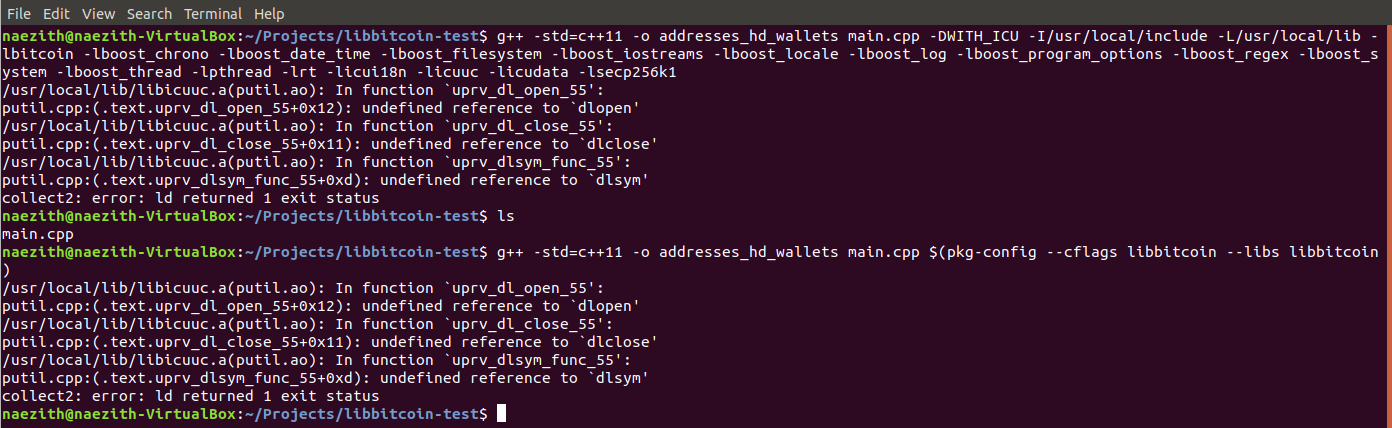
@here it's kinda urgent, can you check if it's a really basic thing?
it's already in pkg-config

naezith16:13
I followed this so version3 https://github.com/libbitcoin/libbitcoin-system#debianubuntu
Other than that, not sure, but the order does matter

neillm16:17
Something seems odd though, perhaps some environmental mismatch. -ldl shouldn't be needed on the static build actually
N
narodnik16:18
The default config file from libbitcoin server needs to be updated (minor change): /subsidy_interval_blocks/subsidy_interval/
what's my issue
naezith16:28
interesting
--static added
-lpthread -ldl -lm while -lpthread -ldl were already there
it gives the same error if I remove that second -lpthread -ldl part
but still keep -lmcan you explain how this works so I can at least learn instead of just being ok that it works 😄 @neillm
g++ -std=c++11 -o addresses_hd_wallets main.cpp -DWITH_ICU -I/usr/local/include -L/usr/local/lib -lbitcoin -lboost_chrono -lboost_date_time -lboost_filesystem -lboost_iostreams -lboost_locale -lboost_log -lboost_program_options -lboost_regex -lboost_system -lboost_thread -lpthread -lrt -ldl -licui18n -licuuc -licudata -lpthread -ldl -lm -lsecp256k1this is the working line
notice that
-lpthread -ldl is duplicatebut two of them are already there
my problem is already solved though, thank you
I just wanna learn how this works