
Bitcoin full node and query server
May 2023
Archive of the libbitcoin Slack #general channel.
Monday, May 1, 2023

evoskuil05:18
It looks like we can get nearly the full benefit of the no-iostream reader implementations that used above but in a fully generalized manner. The reader/writer/flippers accept an IStream/OStream/IOStream template argument. This isn't required to derive from the std iostream interface, just to implement a subset of it. By implementing the simple subset used by reader and writer, this can be passed into any of the byte or byte reader/writer/flipper implementations and based on a comparison of my ad-hoc reader/writer that cut confirmation time by around 55%, it should be very similar.
This supports store serialization, network serialization, header/tx identity hashing, and consensus serialization for signature hashing. Basically everywhere we stream in/out of a fixed buffer. We could also implement a variation for dynamic buffering, but there isn't presently call for it. It looks to be about 1 days work to implement IStream/OStream and one that inherits both (IOStream), including tests.
Applying these in the various scenarios is then trivial work, just swapping stream types.
I did some performance analysis against store reading, which basically amounts to reading txs. This was improved slightly by the new reader, but the bulk of work is in the input/witness/output and these three components are still using the std::iostream reader because (only) these using the chain object serialization. The tools showed that the bulk of time was spent in these specific areas. This is to be expected, as this is the bulk of the store data - but this should then results in comparable improvement in both download/store and read (for validation).
So tomorrow is implementation of the light streams:
simple_ostream

    exception type: OStream::failure
    position type (signed): OStream::pos_type

    enum flags: OStream::rdstate
    {
        goodbit,
        eofbit,
        failbit,
        badbit
    }

    OStream::pos_type tellp();
    OStream::rdstate rdstate();
    void setstate(OStream::rdstate);
    void write(const char*, OStream::pos_type);

    void flush();

simple_istream

    exception type: IStream::failure
    position type (signed): IStream::pos_type

    enum flags: IStream::rdstate
    {
        goodbit,
        eofbit,
        failbit,
        badbit
    }

    enum flags: IStream::seekdir
    {
        beg,
        end,
        cur
    }

    IStream::pos_type tellg();
    IStream::rdstate rdstate();
    void setstate(IStream::rdstate);
    void read(char*, IStream::pos_type);

    int peek();
    void clear();
IStream::pos_type seekg(IStream::pos_type, IStream::seekdir);evoskuil05:29
It's not entirely clear to me why the std::iostreams produce so much overhead. This is a set of boost templates that we use to build the stream objects. But there's clearly a significant amount of overhead. It appears to be largely in the construction of the stream, as reported by the perf tool.
Tuesday, May 2, 2023
evoskuil09:36
So tomorrow is implementation of the light streams
Complete and tested in system, istream, ostream, iostream. Will integrate with database tomorrow.
(edited)Thursday, May 4, 2023

pmienk18:46
Topic: Dev Weekly Status
Time: May 4, 2023 01:00pm Pacific Time (US and Canada)
Join Zoom Meeting
https://us05web.zoom.us/j/87666370902?pwd=bEZDUlJ0MGJ5V3dVMUhVdHl5QzdFdz09
Meeting ID: 876 6637 0902
Passcode: 85U0bF
Saturday, May 6, 2023
evoskuil03:16
I merged updates to system that patch a conditional build problem that arose after @pmienk incorporated the defines defines. Also a new simple iostream object that maps a buffer without implementing the full std::iostream interface or being built from boost::iostream devices. Initial tests showed this to reduce the cost of database operations to 40% of the cost under iostreams. This was identified using the msvc performance profiler.
👍 2👍🏾 1
evoskuil03:49
Just completed a quick run of
set_strong using the new generalized simple iostreams. These are passed into the system read/writer as opposed to the previous iteration which ad-hocked a reader and writer, so there is one level of indirection/containment here that wasn't present in the previous test. The is resulted in a 123% of the previous run. The previous run was 35% of the std::iostreams unoptimzed run, and this new run is 43% of that run. New run in gray.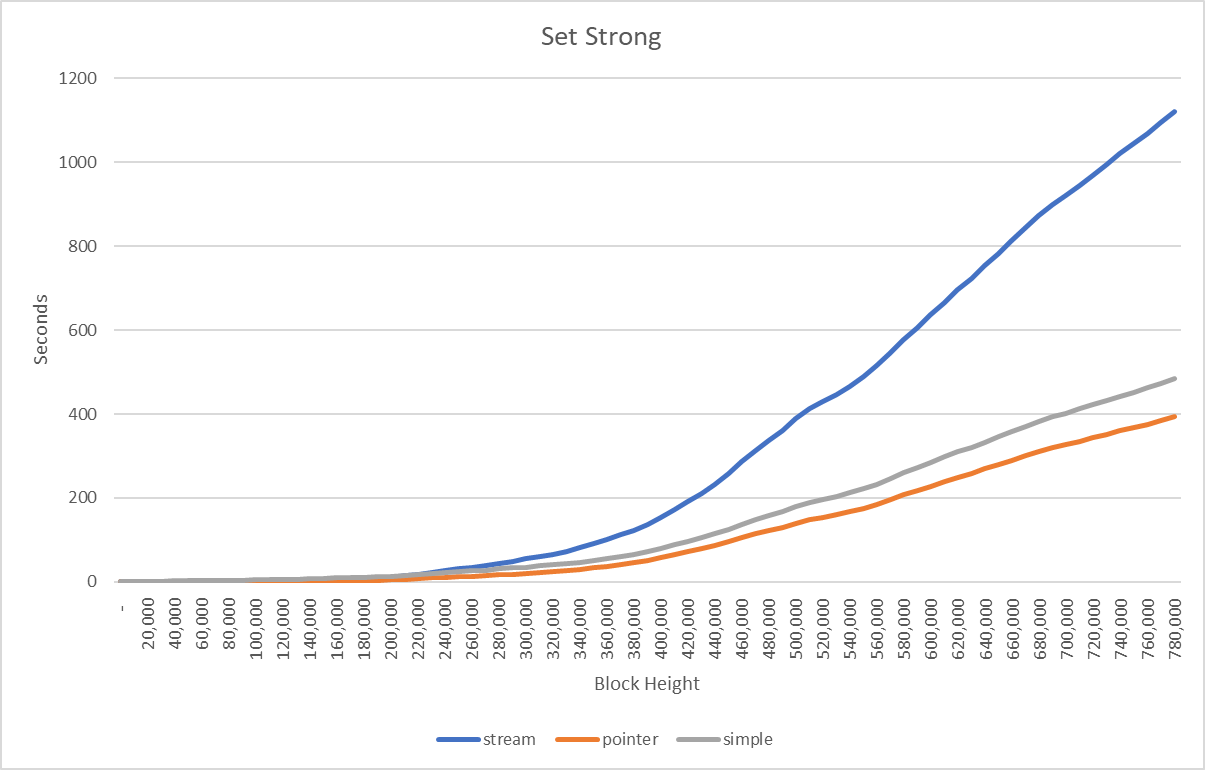
evoskuil05:41
While we can still use the fully-optimized streamers for most database calls, we must either use this new mostly-optimized form for input/output script and witness reads or must extend the fully self-contained reader/writers to implement the bytereader/bytewriter interface. So while that remains possible this is a far more elegant and simple optimization and gets us very close.
evoskuil05:47
This is partial completion of the fully-optimized full store read in relation to the same optimizations. Note that this one is significantly better because the "pointer" optimization did not optimize for scripts and witnesses.
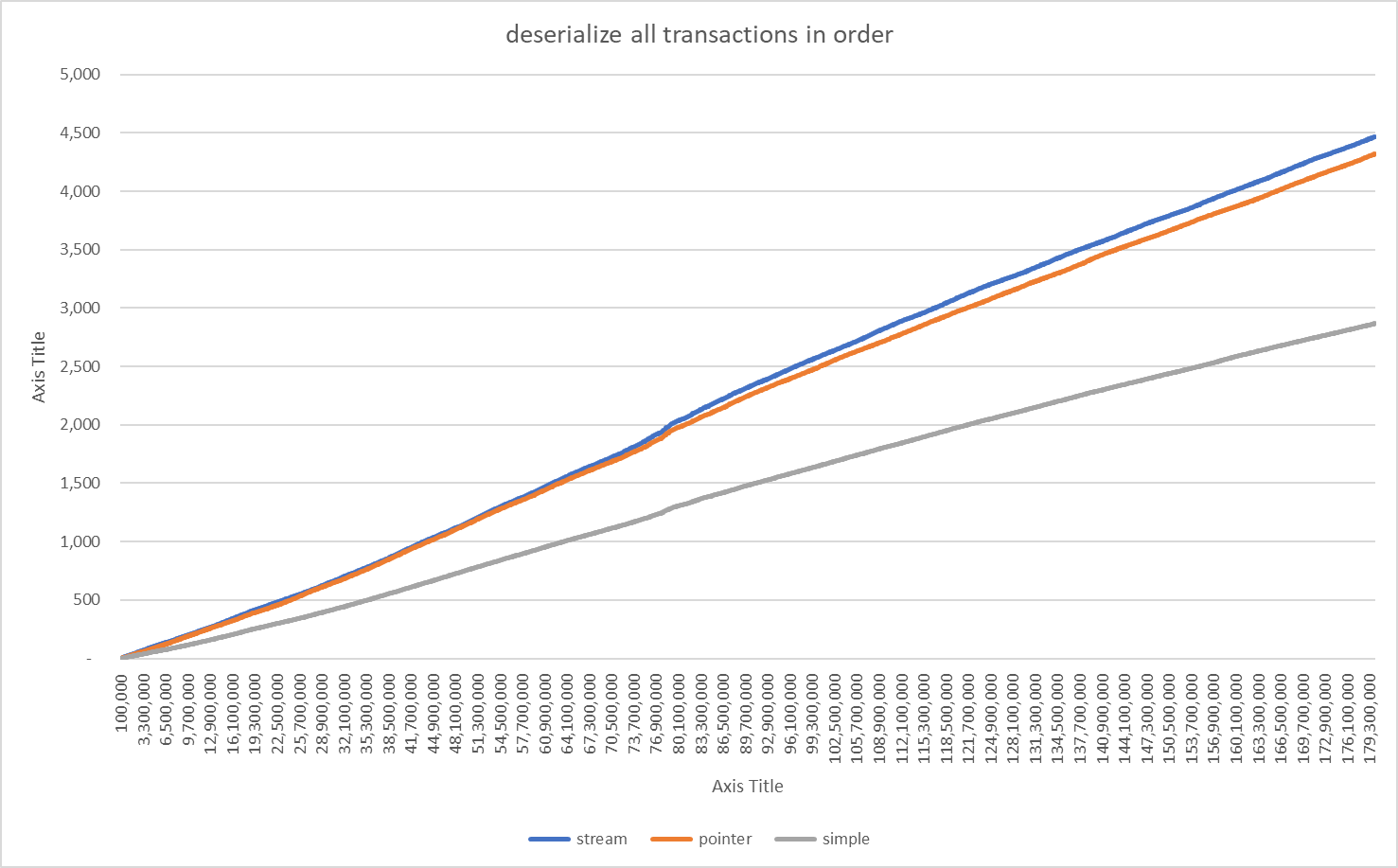
This is tracking at 64% of "original" and 66% of the previous ("pointer") optimization.
Was hoping for 50%, but if 64% holds up that's still good, a reduction from 6 to 4 hours for sequential read. The remaining question is how much performance on a memory constrained machine will be impacted by reading txs that have been written out of order.
This could similarly benefit from the fully-denormalized reader, picking up maybe another 8% from baseline.
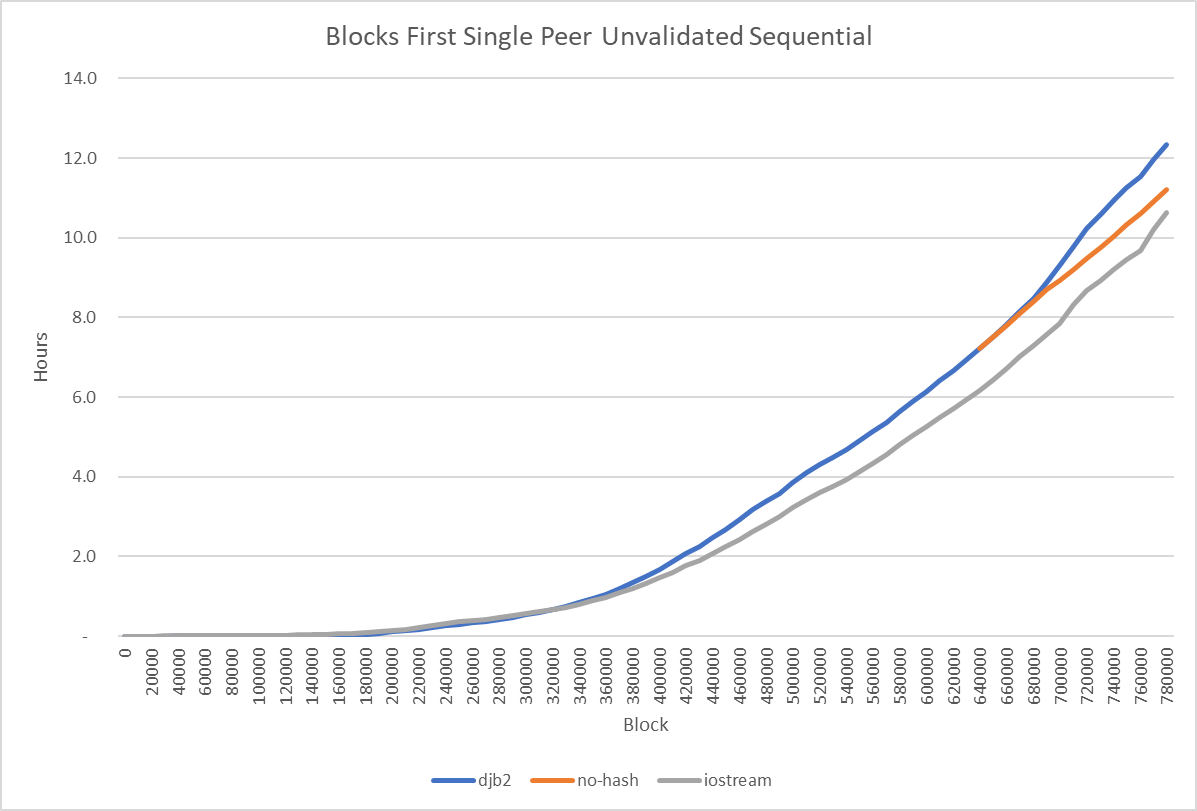
Once this completes I'll run a full sequential sync, with the expectation that store serialization will be similarly faster. However the long pole may be network deserialization. So following that completion I'll apply the simple stream optimization to network I/O as well and run it again. If we get a comparable reduction, sequential sync off of our canonical peer node would drop from 12 to 8 hours.
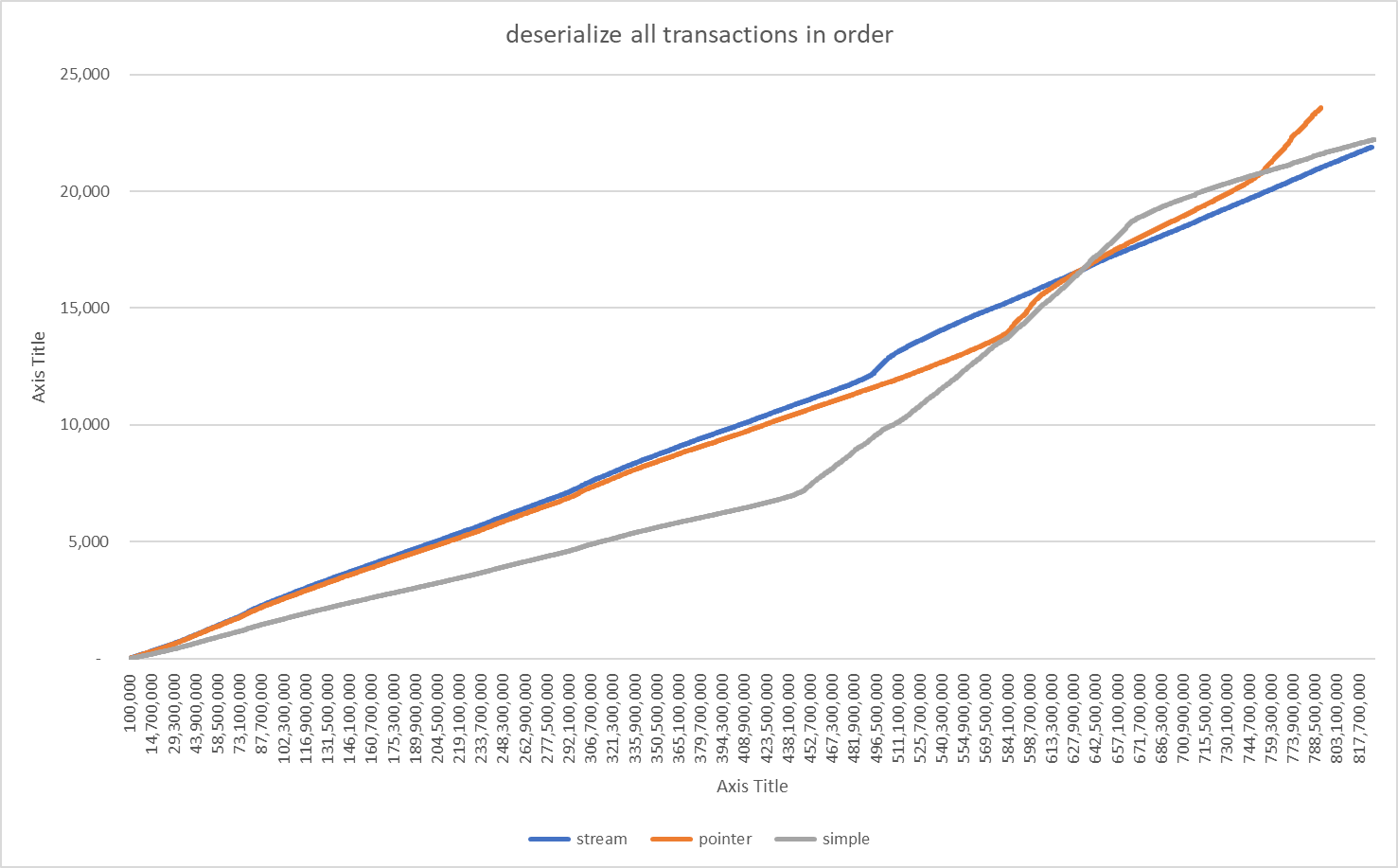
Note the obvious inflection points, where the slope increases dramatically. This is the point at which memory becomes filled (256GB) and inefficient paging results. The following points where the slope returns is a restart of the run - in the blue and gray cases. I don't think I restarted it in the orange case. In the orange case I believe the OS dumped about half of the memory, which resolved the issue until it occurred a second time.
What's interesting is that performance returns almost immediately after a restart. In other words, performance is only marginally dependent upon the memory cache. The caching of pages is actually hurting performance in the case where a limit is hit, vs. no caching at all.
evoskuil21:12
But as for the effectiveness of the stream optimization on reads, a projection (i.e. not memory bound) of the gray run completes at 3.75 hours whereas the blue run projects to 5.83 hours. The optimization itself is 64% of the original time and 69% of the partial (orange) optimization. In other words, current implementation can sequentially read and deserialize the full chain in 3.75 hours if not memory bound (or if caching is somehow more optimally performed).
Sunday, May 7, 2023
evoskuil00:01
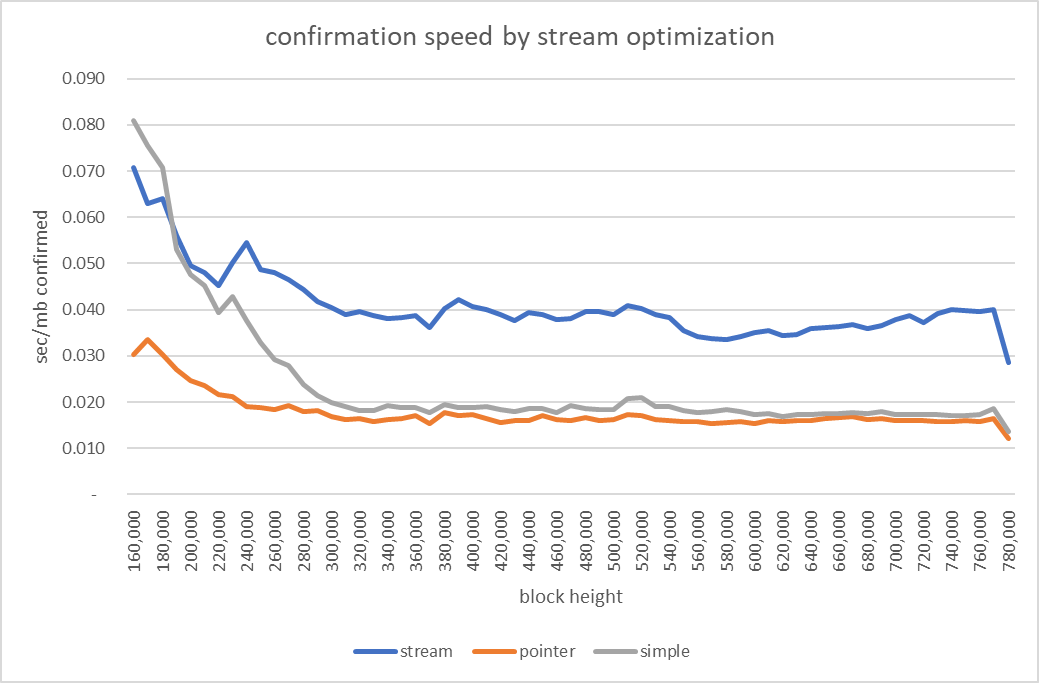
Here's full confirmation runs (vs. just set_strong) relative cost (vs. cumulative). The higher level abstraction creates an expected cost of a few percent, with no offsetting benefit - since only script/witness would be improved and there's none of that in confirmation. But I can't yet explain why (gray) performance is up to 3x worse (than blue) when blocks are small. It should never be worse than the full stream generalization. But the total impact is modest. 2.62 hours to confirm vs. 2.25.
👀 1
evoskuil03:56
Ok, ran some tests and determined that the difference with the early blocks is entirely caching. The OS caches memory map between runs, and I don't yet have a reliable way to clear the cache. With previously-cached tables the performance is consistent across the block range. The preceding scenarios had both been run with caching in the early stages. In the later stages (fuller blocks) the relative benefit is practically eliminate.
(edited)👍 1
evoskuil20:28
This (series 4/yellow) is a full sync run with the optimized stream. Sync runs currently rly on a single peer speed, and I seem to have lost my two performance-reliable peers (became unreliable). I couldn't find one that was comparable, so ran against one that was about 50% slower in terms of full header sync. This still outperformed the previous runs.
(edited)2 replies · jungly, evoskuil · last May 23, 2023

jungly01:21
We might need to have a bitcoind instance running locally to avoid such surprises, and thus have a controlled performance testing environment.
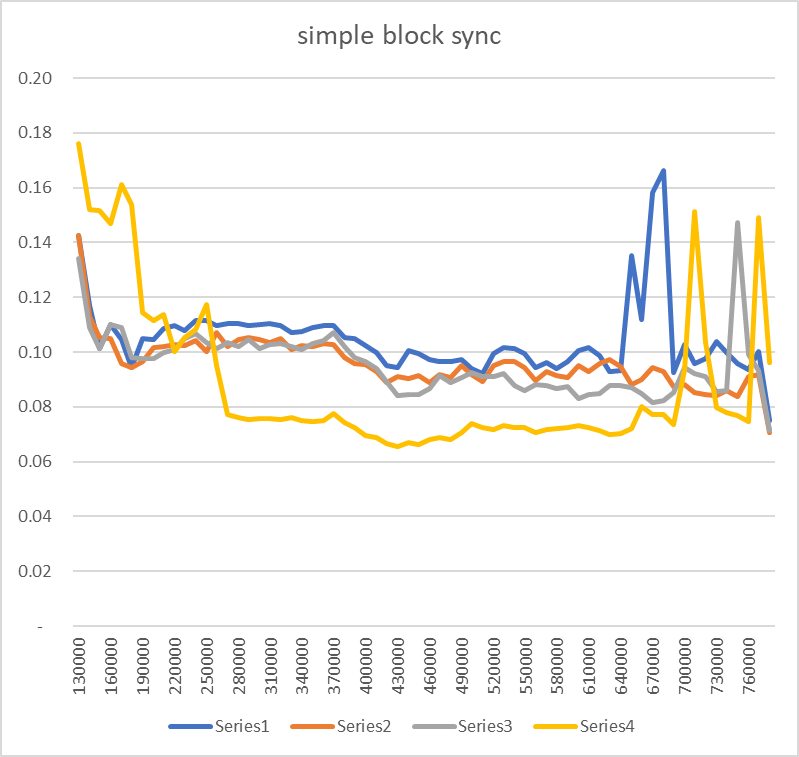
For sync this change is expected to be pure improvement and that appears to be the case, but a little harder to measure.
Tuesday, May 9, 2023
evoskuil07:25
Completed the integration of the simple iostream with all network serialization/deserialization and also header/tx hash and signature hash computations. Hard to get a good measure of benefit without a consistent/baseline peer, but the performance analyzer is now showing a pattern I haven't seen before. With validation disabled there are no actual hotspots, tiny values all over. And with validation enabled all hotspots are in libsecp256k1 (signature validation) and a much more modest level in signature hashing and script execution generally. This is what we should expect to see under ideal circumstances.
So we're getting to the point where it's time to move on from store optimization and evaluation and get back to networking, with store integration. This would start with implementation of the parallel block downloader with optimized peer selection. The initial target would be to download and store the entire chain in less than one hour on a 1Gbit connection (though I typically see closer to 900Gbit up/down).
👍 2
evoskuil07:49
But first I'm going to take a little detour into a script serialization optimization. Planning to replace the use of
shared_ptr op-data with unique_ptr. These were originally created under the assumption that shared_ptr would be the basis of script evaluation, but the generalization to external_ptr made that unnecessary. unique_ptr eliminates one word per op-data instance and eliminates mutex locks internal to shared_ptr. And since a large percentage of these are nullptr and scripts are the bulk of the chain, this should be a material optimization, and simple.1 reply · evoskuil · last Jan 26, 2024
evoskuil02:18
I just spent some time on this and it's a bit more change than I anticipated, while the performance result may end up being an even tradeoff. Hard to say but setting this aside for now.
evoskuil07:53
Overall the store work has come out exceptionally well. system, store, network, and node have proven exceedingly reliable - in fact I'd even dare to say perfectly reliable. In the store work the main issues I had to work through were performance optimization around table structure and some regressions in chain validation due to the full rewrite. The only significant issue, which should not be understated, is thrashing of the memory maps when memory becomes full during significant reading.
🎉 4
Thursday, May 11, 2023
pmienk18:30
Topic: Dev Weekly Status
Time: May 11, 2023 01:00pm Pacific Time (US and Canada)
Join Zoom Meeting
https://us05web.zoom.us/j/87666370902?pwd=bEZDUlJ0MGJ5V3dVMUhVdHl5QzdFdz09
Meeting ID: 876 6637 0902
Passcode: 85U0bF
Thursday, May 25, 2023
pmienk19:00
Topic: Dev Weekly Status
Time: May 25, 2023 01:00pm Pacific Time (US and Canada)
Join Zoom Meeting
https://us05web.zoom.us/j/87666370902?pwd=bEZDUlJ0MGJ5V3dVMUhVdHl5QzdFdz09
Meeting ID: 876 6637 0902
Passcode: 85U0bF