
Bitcoin full node and query server
December 2024
Archive of the libbitcoin Slack #general channel.
Tuesday, December 3, 2024

evoskuil05:46
I had a typo in a constant that was preventing the shani rounds from functioning correctly, but that is all resolved. There's a significant efficiency loss somewhere, likely in the way I've fit the sha intrinsics into the existing template structure. I'll be working to track that down, but it is functional at this point.
(edited)🎉 1
Wednesday, December 4, 2024
evoskuil02:39
I took a bit of a detour today on additional sha vectorizations. I added the vectorization of endianness conversions and or k-adding. I recently moved k-adding to its own function with additions enumerated across the buffer, but there was a bug in the vectorization. I tracked that down today and was able to enable this and the vectorized endianness conversions.
These save approximately a total of 5% for smaller hashing runs, declining as the size of the buffer increases. They also save 1-3% of Merkle hashing runs, again with the primary benefit on the low end (this makes sense as they only affect the 1/2/3 lane merkle hashes (unvectorized)).
(edited)These numbers are without avx512, which doubles the vectorization lanes, since I don't have a test platform for it yet.
evoskuil02:48
We are able to take advantage of several vectorizations that Core and typical hash libraries cannot, because we use buffered scheduling of the message, as opposed to variable rotation. This uses more memory, but allows significant net time savings through vectorization. The sha256 buffer is 4x the 64 byte block size, rotating. So that's not really significant. So we vectorize across the message buffer: sigma computations, endianness conversion, and k-addition but also vectorize across multiple message buffers (the other axis), and finally vectorize across independent hashes for Merkle (which Core does as well).
Even without avx512 (just avx2/sse4) this reduces non-Merkle hashing to 70-75% of the normal form (based on Core implementation) for larger amounts of data, and 90% for smaller data. And down to as low as 80% of normal for on small data due to precomputed padding.
This is all C++ (no C and no assembly) in a single template, which also includes the same optimizations for sha512 and sha160 where applicable.
I ran into an issue on clang (non-xcode) with the two new optimizations, so I've disabled those on that platform until these can be isolated. So now back to refactoring the shani implementation.
C
cguida16:19
Hey @evoskuil do you have that bn.exe binary you used to do the Windows benchmark? I got the same hardware and I want to replicate your result :)
evoskuil16:34
Sure, I'll build a current copy and run it to verify. What's your measured bandwidth?
🔥 1
36 replies · cguida, evoskuil · last Dec 11, 2024
evoskuil17:35
Well that's only 27% of what I'm testing on, and since it's network bound on my network, it will be as well on the same machine on a slower network. So you should expect it to take around 3.7 hours.
🔥 1
C
cguida17:40
Haha it’s super fast for the country i’m in. Btw the machine cost US$530 here because of silly import duties as well.
Again, 3.7 hours on a US$530 machine is still an amazing result, looking forward to confirming 🙂
evoskuil17:41
I'm waiting for it to complete. Once that's done I'll post you a zip with the executable. The command line is simply > bn
🙏 1
evoskuil17:48
It generates a rotating pair of log files named
bn_end.log and bn_begin.log (the combined size can be configured). It starts with end and then rotat3es it over to begin and so-on. These are currently just an echo of whatever hits the console. The console and logs are buffering, so pausing the console doesn't really slow the node. The log will start with an entry that shows the name of the config file its using (or default) so you know if it has your config.
2024-11-24T19:39:57Z.0 ====================== startup =======================
2024-11-24T19:39:57Z.0 Using config file: "m:\\bn.cfg"
There's also some logging options dumped at the start of the log. Since log levels (and their message generation) can be entirely compiled out, this gives you some good info.
2024-11-24T19:39:57Z.0 Version Information...
libbitcoin-node:       4.0.0
libbitcoin-database:   4.0.0
libbitcoin-network:    4.0.0
libbitcoin-system:     4.0.0
2024-11-24T19:39:57Z.0 Press CTRL-C to stop the node.
2024-11-24T19:39:57Z.0 Log system configuration...
2024-11-24T19:39:57Z.0 [a]pplication.. compiled:1 enabled:1.
2024-11-24T19:39:57Z.0 [n]ews......... compiled:1 enabled:1.
2024-11-24T19:39:57Z.0 [s]ession...... compiled:1 enabled:1.
2024-11-24T19:39:57Z.0 [p]rotocol..... compiled:1 enabled:0.
2024-11-24T19:39:57Z.0 [x]proxy....... compiled:1 enabled:0.
2024-11-24T19:39:57Z.0 [r]emote....... compiled:1 enabled:1.
2024-11-24T19:39:57Z.0 [f]ault........ compiled:1 enabled:1.
2024-11-24T19:39:57Z.0 [q]uitting..... compiled:1 enabled:0.
2024-11-24T19:39:57Z.0 [o]bjects...... compiled:0 enabled:0.
2024-11-24T19:39:57Z.0 [v]erbose...... compiled:1 enabled:0.
2024-11-24T19:39:57Z.0 Please wait while network is starting...
2024-11-24T19:39:57Z.1 Candidate top [000000000019d6689c085ae165831e934ff763ae46a2a6c172b3f1b60a8ce26f:0].
2024-11-24T19:39:57Z.1 Fork point (0) unassociated (0).
2024-11-24T19:39:57Z.1 Loaded (10000) addresses.
2024-11-24T19:39:57Z.1 Bypassed seeding because of sufficient (10000 of 1000) address quantity.
2024-11-24T19:39:57Z.0 Node is started.
2024-11-24T19:39:57Z.1 Not configured for inbound connections.
2024-11-24T19:39:57Z.1 Create 200 connections 5 at a time.
2024-11-24T19:39:57Z.0 Node is running.
👍 1
evoskuil17:50
Windows Defender might flag the process. I don't think it's infected, but the process behavior is obviously a bit scary. If so you might need to give the file an exclusion or turn off Defender.
👍 1
evoskuil17:59
The recommended config for a milestone sync benchmark on this machine is the default config. There are a lot of (1) config settings, (2) command line options, and (3) runtime console options. Config settings are in an "ini" file format, and established using the
--config or -c command line switch as described above. The --help or -h command dumps command line options:
>bn -c m:\bn.cfg -h

Usage: bn [-abdfhiklnrstvw] [--config value]

Info: Runs a full bitcoin node.

Options (named):

-a [--slabs]         Scan and display store slab measures.
-b [--backup]        Backup to a snapshot (can also do live).
-c [--config]        Specify path to a configuration settings file.
-d [--hardware]      Display hardware compatibility.
-f [--flags]         Scan and display all flag transitions.
-h [--help]          Display command line options.
-i [--information]   Scan and display store information.
-k [--buckets]       Scan and display all bucket densities.
-l [--collisions]    Scan and display hashmap collision stats (may exceed
                     RAM and result in SIGKILL).
-n [--newstore]      Create new store in configured directory.
-r [--restore]       Restore from most recent snapshot.
-s [--settings]      Display all configuration settings.
-t [--test]          Run built-in read test and display.
-v [--version]       Display version information.
-w [--write] Run built-in write test and display. (edited)evoskuil18:00
Many of these options are for developer troubleshooting and store sizing. The
(edited)--settings option dumps the entire set of config file settings and descriptions. It's a lot and again many of these are to aid tuning, but some are for general purpose use.evoskuil18:09
When the node is running, at the console you can enter various commands by hitting a letter key and then <enter>. The combination
m <enter> brings up the console menu. These consist of toggles and options. Toggle varies the log levels that are compiled in (all except for objects in this build. I don't recommend leaving highly verbose levels turned on for a long time, it just wastes time.
2024-12-04T18:06:13Z.0 Toggle: [a]pplication
2024-12-04T18:06:13Z.0 Toggle: [n]ews
2024-12-04T18:06:13Z.0 Toggle: [s]ession
2024-12-04T18:06:13Z.0 Toggle: [p]rotocol
2024-12-04T18:06:13Z.0 Toggle: [x]proxy
2024-12-04T18:06:13Z.0 Toggle: [r]emote
2024-12-04T18:06:13Z.0 Toggle: [f]ault
2024-12-04T18:06:13Z.0 Toggle: [q]uitting
2024-12-04T18:06:13Z.0 Toggle: [o]bjects
2024-12-04T18:06:13Z.0 Toggle: [v]erbose
2024-12-04T18:06:13Z.0 Option: [b]ackup the store
2024-12-04T18:06:13Z.0 Option: [c]lose the node
2024-12-04T18:06:13Z.0 Option: [e]rrors in store
2024-12-04T18:06:13Z.0 Option: [g]o network communication
2024-12-04T18:06:13Z.0 Option: [h]old network communication
2024-12-04T18:06:13Z.0 Option: [i]nfo about store
2024-12-04T18:06:13Z.0 Option: [m]enu of options and toggles
2024-12-04T18:06:13Z.0 Option: [t]est built-in case
2024-12-04T18:06:13Z.0 Option: [w]ork distribution
2024-12-04T18:06:13Z.0 Option: [z]eroize disk full error
evoskuil18:10
You cannot really track progress from watching the log levels. There is a high speed event log that emits messages to a file sink (
events.log) presently. You can use this to track the number of archivals (a block that's downloaded, checked, stored and indexed.
block_archived...... 551105 1217
block_archived...... 565941 1217
block_archived...... 563597 1217
block_archived...... 562631 1217
block_archived...... 571193 1217
block_archived...... 567873 1217
block_archived...... 589292 1217
block_archived...... 559177 1217
block_archived...... 572302 1217
block_archived...... 550289 1217
block_archived...... 587634 1217
block_archived...... 584910 1217
block_archived...... 564990 1217
block_archived...... 567301 1217
evoskuil18:12
Since these are out of order you should rely on the file line count to see the number of blocks downloaded. The default config is milestoned to 850k, and validate/confirm are disabled. Blocks get a tad bit slower above 850k, and also at the tail end of the chain just because there are fewer blocks remaining.
evoskuil18:14
The commands work at any time the node is running.
<ctrl>-c stops the process normally, or you can also use c <enter>. If you type multiple or wrong characters at the command line, just hit <enter> to clear them, which you'll see at the console once it clears. Note that the node is highly asynchronous, so sometimes console actions are not immediate, but generally it's pretty quick.evoskuil18:16
This is the
i <enter> command at runtime (it provides a little more at the command line):
2024-12-04T18:12:49Z.0 Body sizes...
   header    :85577716
   txs       :4520884072
   tx        :69884209602
   point     :101072408544
   input     :390667618129
   output    :107407237477
   puts      :26885386434
   candidate :2619726
   confirmed :3
   spend     :67402563504
   strong_tx :12387474660
   valid_tx  :0
   valid_bk  :0
   address   :0
   neutrino  :0
2024-12-04T18:12:49Z.0 Table records...
   header    :873242
   tx        :1127164671
   point     :2807566904
   candidate :873242
   confirmed :1
   spend     :2808440146
   strong_tx :1032289555
   address   :0
2024-12-04T18:12:49Z.0 Head buckets...
   header    :524493
   txs       :524493
   tx        :551320125
   point     :546188501
   spend     :1459791875
   strong_tx :551320125
   valid_tx  :551320125
   valid_bk  :524493
   address   :1
   neutrino  :1
2024-12-04T18:12:49Z.0 Collision rates...
   header    :1.66493
   txs       :1.66493
   tx        :2.04448
   point     :5.14029
   spend     :1.92386
   strong_tx :1.8724
   valid_tx  :2.04448
   valid_bk  :1.66493
   address   :0
   neutrino  :0
(edited)
evoskuil18:18
Shutdown time from the full chain sync was 10 seconds:
2024-12-04T18:18:02Z.0 Database stopped successfully in 10 secs.
2024-12-04T18:18:02Z.0 Node stopped successfully.
2024-12-04T18:18:02Z.0 ====================== shutdown ======================
2024-12-04T18:18:02Z.0 Press <enter> to exit...
evoskuil18:21
You should always terminate the process normally, or it will require a full resync from the last snapshot. You can establish snapshots while running or once it's complete, or at the command line. Automatic snapshotting is currently off by default. A snapshot pauses the network and takes a couple minutes. There are only two in rotation. Restore is automatic, or can be invoked at the command line. If the disk fills it is detected, and will resume once space is available, or can be shut down normally.
(edited)👍 1
evoskuil18:26
The store can also be hot backed-up from the file system, and will automatically recover to the last snapshot. So for hot backup simply snapshot first and then copy the directory once that completes, while it's running.
evoskuil18:35
You will probably have to configure seed nodes manually. The ones configured by default are probably not running. This can be done in the config file, any number of entries:
[network]
seed = ip:port
seed = host:port
👍 1
evoskuil18:37
By default the node maintains 10,000 host names in a text file named
hosts.cache . IPv6 is supported but disabled by default. To skip seeding you can also just place this file in the network directory, as long as there are at least 500 entries (by default).C
cguida00:15
Ok upon closer inspection the sync took 7605 seconds which is 126.75 minutes or 2.11 hours
C
cguida00:16
I am incredibly psyched about this result!!
I am in awe of the work you guys are doing!
🤙🏻 1
C
cguida00:16
I'm wondering if the sync time would be massively impacted with only 16GB ram instead of 32...
evoskuil17:25
I just added some minor sha256 optimizations (vectorization), seems to have given it a bit of a boost. Still no shani but that's getting close. This is what the run looks like half way through on 2.3Gbps Internet.
(edited)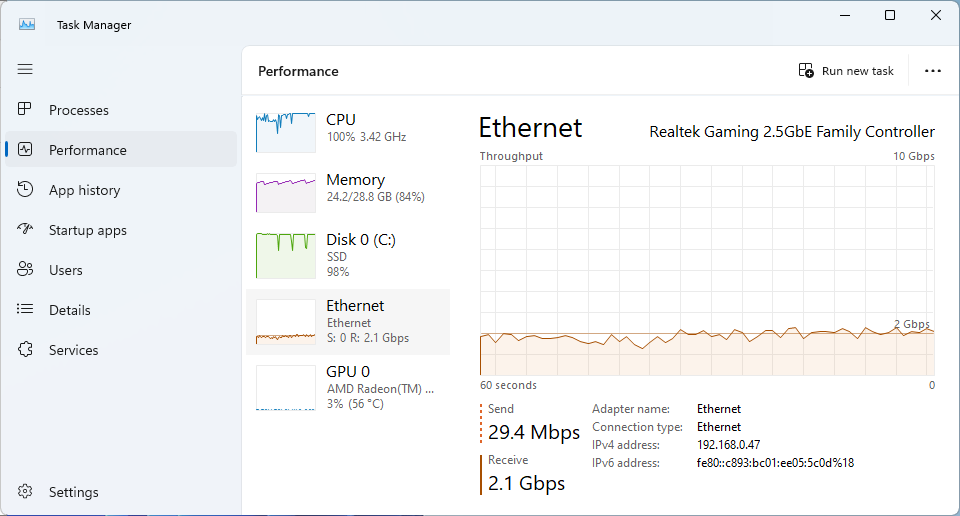
C
cguida17:34
Also curious how the Linux benchmark is going, definitely want to get that up to speed with the Windows version if possible! All my nodes are Linux due to working better with Lightning
evoskuil18:23
Linux and macos are tested and run, but they have not been performance tuned and there is some issue on both that causes them to be very slow while using few resources. I haven't spent any time on it. Pretty busy lately and have prioritized getting shani integrated and validate/confirm fully tuned.
1 reply · cguida · last Dec 04, 2024
Thursday, December 5, 2024
evoskuil02:15
Initial implementation with shani accelerates sha256 to 18% of canonical algorithm and 19% of vectorized optimizations. IOW the current hashing code takes 5.5x more time than this new code on machines with shani. This will also accelerate the 1/2/3 lane hashing for merkle roots. This should dramatically lower CPU utilization on the mini.
(edited)evoskuil04:48
It looks like a partial integration of shani has knocked 15% off the mini sync time. I inadvertently ran it with automated snapshots and a block upper limit. Running it again now, but I think it will hit around 45 minutes to block 850k.
evoskuil05:56
I ordered another one of these PALADN minicomputers, but with the AVX512 (and AVX2/SSE4/SHA like the ones I have) CPU, $421 delivered. This will allow me to run with all of our hardware accelerations.
The theoretical limit on my 2.3Gbps network is 34 minutes. We are only 9 minutes above the time it would take to download the full set of blocks in a single file.
This is on a $350 Windows PC. With AVX512 and the completion of the SHA-NI integration, we'll shave a few minutes more off of the total time.
(edited)2 replies · pmienk, jungly · last Dec 05, 2024


Huddle with evoskuil, Marnix, jungly, parsevalbtc, pmienk · 97 min21:08
Friday, December 6, 2024
evoskuil06:19
Took me all evening to track down a simple issue in the single block shani optimization (difference in endianness between the buffered and rotating sha algorithms). But we are now getting the same 5x benefit for single and padding blocks. Just a little more to do to get half and dual half blocks integrated, which target double hashing and Merkle hashing respectively.

neillm13:37
All the work lately has been awesome! Just wondering, is there an isolated benchmark or test I could use to test out
sha_ni perf on Linux (AMD Ryzen 9 7950X 16-Core Processor)?Separately, I'd like to compare your test run times, but my bandwidth is limited to 300Mbps. Your bandwidth is impressive 😅
(edited)There are hashing performance tests in the system test project. Because they are slow they have to be turned on by enabling HAVE_PERFORMANCE_TESTS:
/// Have slow test execution (scrypt is slow by design).
////#define HAVE_SLOW_TESTS
////#define HAVE_PERFORMANCE_TESTS
🙏 1
The test lib has a full canonical implementation of sha256 and ripemd, derived from Core, and a custom test runner and timer in performance.hpp. Test cases are in performance.cpp.
The
AMD Ryzen 9 7950X has shani as well as sse4, avx2, and avx512. I haven't been able to perf test with avx512 yet but it's implemented.18 replies · neillm, evoskuil · last Dec 06, 2024
neillm15:33
Ah, that would explain why I'm seeing a build error with avx512 enabled! Here for reference:
... snip ...
                 from ./include/bitcoin/system/settings.hpp:22,
                 from ./include/bitcoin/system.hpp:29,
                 from examples/main.cpp:21:
./include/bitcoin/system/intrinsics/xcpu/functional_512.hpp: In function 'libbitcoin::system::xint512_t libbitcoin::system::add(xint512_t, xint512_t)':
./include/bitcoin/system/intrinsics/xcpu/functional_512.hpp:163:31: error: cannot convert 'libbitcoin::system::xint512_t' {aka '__m512i'} to '__m256i'
  163 |         return mm256_add_epi8(a, b);
      |                               ^
      |                               |
      |                               libbitcoin::system::xint512_t {aka __m512i}
./include/bitcoin/system/intrinsics/xcpu/defines.hpp:224:61: note: in definition of macro 'mm256_add_epi8'
  224 |     #define mm256_add_epi8(a, b)            _mm256_add_epi8(a, b)
      |                                                             ^
In file included from /usr/lib/gcc/x86_64-linux-gnu/14/include/immintrin.h:53,
                 from /mnt/ssd1/libbitcoin/master/install/include/boost/multiprecision/cpp_int/intel_intrinsics.hpp:83,
                 from /mnt/ssd1/libbitcoin/master/install/include/boost/multiprecision/cpp_int/add_unsigned.hpp:10,
                 from /mnt/ssd1/libbitcoin/master/install/include/boost/multiprecision/cpp_int/add.hpp:12,
                 from /mnt/ssd1/libbitcoin/master/install/include/boost/multiprecision/cpp_int.hpp:2284,
                 from ./include/bitcoin/system/boost.hpp:54,
                 from ./include/bitcoin/system/exceptions.hpp:26,
                 from ./include/bitcoin/system/arena.hpp:22,
                 from ./include/bitcoin/system/allocator.hpp:28,
                 from ./include/bitcoin/system.hpp:17:
/usr/lib/gcc/x86_64-linux-gnu/14/include/avx2intrin.h:105:26: note:   initializing argument 1 of '__m256i _mm256_add_epi8(__m256i, __m256i)'
  105 | _mm256_add_epi8 (__m256i __A, __m256i __B)
      |                  ~~~~~~~~^~~
./include/bitcoin/system/intrinsics/xcpu/functional_512.hpp:165:32: error: cannot convert 'libbitcoin::system::xint512_t' {aka '__m512i'} to '__m256i'
  165 |         return mm256_add_epi16(a, b);
      |                                ^
      |                                |
      |                                libbitcoin::system::xint512_t {aka __m512i}
./include/bitcoin/system/intrinsics/xcpu/defines.hpp:225:62: note: in definition of macro 'mm256_add_epi16'
  225 |     #define mm256_add_epi16(a, b)           _mm256_add_epi16(a, b)
      |                                                              ^
/usr/lib/gcc/x86_64-linux-gnu/14/include/avx2intrin.h:112:27: note:   initializing argument 1 of '__m256i _mm256_add_epi16(__m256i, __m256i)'
  112 | _mm256_add_epi16 (__m256i __A, __m256i __B)
      |                   ~~~~~~~~^~~
./include/bitcoin/system/intrinsics/xcpu/functional_512.hpp:167:32: error: cannot convert 'libbitcoin::system::xint512_t' {aka '__m512i'} to '__m256i'
  167 |         return mm256_add_epi32(a, b);
      |                                ^
      |                                |
      |                                libbitcoin::system::xint512_t {aka __m512i}
./include/bitcoin/system/intrinsics/xcpu/defines.hpp:226:62: note: in definition of macro 'mm256_add_epi32'
  226 |     #define mm256_add_epi32(a, b)           _mm256_add_epi32(a, b)
      |                                                              ^
/usr/lib/gcc/x86_64-linux-gnu/14/include/avx2intrin.h:119:27: note:   initializing argument 1 of '__m256i _mm256_add_epi32(__m256i, __m256i)'
  119 | _mm256_add_epi32 (__m256i __A, __m256i __B)
      |                   ~~~~~~~~^~~
./include/bitcoin/system/intrinsics/xcpu/functional_512.hpp:169:32: error: cannot convert 'libbitcoin::system::xint512_t' {aka '__m512i'} to '__m256i'
  169 |         return mm256_add_epi64(a, b);
      |                                ^
      |                                |
      |                                libbitcoin::system::xint512_t {aka __m512i}
./include/bitcoin/system/intrinsics/xcpu/defines.hpp:227:62: note: in definition of macro 'mm256_add_epi64'
  227 |     #define mm256_add_epi64(a, b)           _mm256_add_epi64(a, b)
      |                                                              ^
/usr/lib/gcc/x86_64-linux-gnu/14/include/avx2intrin.h:126:27: note:   initializing argument 1 of '__m256i _mm256_add_epi64(__m256i, __m256i)'
  126 | _mm256_add_epi64 (__m256i __A, __m256i __B)
      |                   ~~~~~~~~^~~
make: *** [Makefile:4993: examples/libbitcoin_system_examples-main.o] Error 1neillm15:39
With it disabled (run just now):
./configure --with-tests --with-examples --with-pkgconfigdir=/mnt/ssd1/libbitcoin/master/install/lib/pkgconfig --prefix=/mnt/ssd1/libbitcoin/master/install --with-boost=/mnt/ssd1/libbitcoin/master/install --with-zmq --with-zlib --with-icu --with-qrencode --with-png --enable-static --disable-shared --enable-avx2 --enable-shani --enable-sse41
neillm15:40
checking --with-pkgconfigdir option... /mnt/ssd1/libbitcoin/master/install/lib/pkgconfig
checking --with-tests option... yes
checking --with-examples option... yes
checking --with-icu option... yes
checking --enable-avx2 option... yes
checking --enable-avx512 option... no
checking --enable-sse41 option... yes
checking --enable-shani option... yes
checking --enable-ndebug option... yes
checking --enable-isystem option... no
evoskuil15:48
Above is a recent regression (yesterday). I guess we aren't running avx512 on CI unless there's an available platform. I know the tests used to pass that detected it. I'll patch now.
🙏 1
evoskuil15:53
evoskuil15:55
These tests are just Merkle with and without vectorization. They don't include shani. The interesting avx512 test is the ratio of the vector tests to non-vector here. it's about 21% with avx2. I'm expected about 10% with avx512.
evoskuil15:57
The disabled tests below are non-merkle. You can set up
(edited)sha256a_comp (shani) and sha256a_both (shani and vectorization) to get the shani stuff. base_sha256a is the Core baseline.evoskuil15:58
You can do the same for the Merkle tests if you want. There's still several places where shani isn't fully incorporated though. It doesn't currently benefit Merkle.
evoskuil14:51
The total percentage of customers with 1Gbps or higher is 34%, which makes it the most popular internet tier among all Americans.
6 replies · neillm, evoskuil · last Dec 06, 2024
neillm16:09
The big ones in my area top out at just under 1Gbps and it's pricey. I'm on business class internet, but it's quite a jump from where I am. I didn't think to look at AT&T, but as it turns out
AT&T Internet is not available at ... where I need it.neillm16:36
I'll have to look at the internet options here again. When I login, I can see the upgrade plan pricing and it sucks. If I just search (not logged in), I'm seeing some better deals from the same provider 🙄
(edited)evoskuil16:38
Yep, cancel and re-add service. That will get them to give you the current price.
(edited)To compile with intrinsics you need to define each of the symbols for the build (shani, sse41, avx2, avx512).
neillm16:24
Hrm:
$ ./test/libbitcoin-system-test --run_test=performance_tests
Running 2 test cases...

test____________: performance__sha256a_none__merkle
algorithm_______: N10libbitcoin6system3sha9algorithmINS1_4h256ILm256ELb1EEELb0ELb0ELb1ELb1EEE
test_rounds_____: 10240
bytes_per_round_: 1
native__________: 0
vectorized______: 0
cached__________: 1
chunked_________: 0
seconds_total___: 0.437522
mib_per_second__: 0.0223203
cycles_per_byte_: 128180
ms_per_round____: 0.0427268
ms_per_byte_____: 0.0427268
unknown location(0): fatal error: in "performance_tests/performance__sha256a_none__merkle": signal: SIGSEGV, si_code: 128 (memory access violation at address: 0x00000000)
test/hash/performance/performance.cpp(80): last checkpoint: "performance__sha256a_none__merkle" test entry

*** 1 failure is detected in the test module "libbitcoin_test"
Odd, something may be off in general with this build (or my setup/system):
$ ./test/libbitcoin-system-test
Running 3724 test cases...
unknown location(0): fatal error: in "settings_tests/settings__construct__regtest_context__expected": signal: SIGSEGV, si_code: 128 (memory access violation at address: 0x00000000)
test/settings.cpp(171): last checkpoint

*** 1 failure is detected in the test module "libbitcoin_test"
7 replies · neillm, pmienk, evoskuil · last Dec 06, 2024
neillm16:27
In theory, I think my CPU supports all 4 options, but I could try to enable one by one until I see an error
neillm16:31
Right, I thought they were covered though, maybe not:
    Flags:                fpu vme de pse tsc msr pae mce cx8 apic sep mtrr pge mca cmov pat pse36 clflush mmx fxsr sse sse2 ht syscall nx mmxext fxsr_opt pdpe
                          1gb rdtscp lm constant_tsc rep_good amd_lbr_v2 nopl xtopology nonstop_tsc cpuid extd_apicid aperfmperf rapl pni pclmulqdq monitor ss
                          se3 fma cx16 sse4_1 sse4_2 x2apic movbe popcnt aes xsave avx f16c rdrand lahf_lm cmp_legacy extapic cr8_legacy abm sse4a misalignsse
                           3dnowprefetch osvw ibs skinit wdt tce topoext perfctr_core perfctr_nb bpext perfctr_llc mwaitx cpb cat_l3 cdp_l3 hw_pstate ssbd mba
                           perfmon_v2 ibrs ibpb stibp ibrs_enhanced vmmcall fsgsbase bmi1 avx2 smep bmi2 erms invpcid cqm rdt_a avx512f avx512dq rdseed adx sm
                          ap avx512ifma clflushopt clwb avx512cd sha_ni avx512bw avx512vl xsaveopt xsavec xgetbv1 xsaves cqm_llc cqm_occup_llc cqm_mbm_total c
                          qm_mbm_local avx512_bf16 clzero irperf xsaveerptr rdpru wbnoinvd cppc arat npt lbrv svm_lock nrip_save tsc_scale vmcb_clean flushbya
                          sid decodeassists pausefilter pfthreshold avic vgif x2avic v_spec_ctrl vnmi avx512vbmi umip pku ospke avx512_vbmi2 gfni vaes vpclmul
qdq avx512_vnni avx512_bitalg avx512_vpopcntdq rdpid overflow_recov succor smca fsrm flush_l1d amd_lbr_pmc_freezeevoskuil16:31
These tests determine exactly what is present that we need, and can be run from a default build. https://github.com/libbitcoin/libbitcoin-system/blob/master/test/intrinsics/haves.cpp
evoskuil16:29
Yeah, that looks like non-support. There is test code to determine what the CPU supports (from a default build).
The node will provide that info on the command line.
26 replies · neillm, evoskuil · last Dec 06, 2024
neillm16:39
That's a great feature btw (older bin)
$ ./master/install/bin/bn -d
Intrinsics...
arm..... platform:0.
intel... platform:1.
avx512.. platform:1 compiled:0.
avx2.... platform:1 compiled:1.
sse41... platform:1 compiled:1.
shani... platform:1 compiled:0.
neon.... platform:0 compiled:0.
evoskuil16:42
So run the tests without it and if ok that means it's prob just a bug in our avx512 feature.
(edited)neillm16:58
Still no go, and this is with only shani and sse41
$ ./test/libbitcoin-system-test
Running 3716 test cases...
unknown location(0): fatal error: in "settings_tests/settings__construct__regtest_context__expected": signal: SIGSEGV, si_code: 128 (memory access violation at address: 0x00000000)
test/settings.cpp(171): last checkpoint

*** 1 failure is detected in the test module "libbitcoin_test"
neillm17:15
I am suspecting that, but can find out for sure. It's working btw w/o any flags enabled. Worth letting it run to get the baseline
evoskuil17:21
Ok, I had to disable a couple new vectorization optimizations in non-macos clang due to these type of failures. gcc, XCode and msvc have been fine tho.
neillm17:23
Hrm, so how do I log the test results to a file? I'm trying to redirect stdout/stderr and it's not showing up
evoskuil17:24
I suspect they have to do with memory alignment, but the techniques work in other similar areas on clang, and I’ve tried making sure that loadu and storeu are comprehensively used, but no luck.
👍 1
neillm17:24
hwloc-bind --cpubind core:5 -- ./test/libbitcoin-system-test --log_level=all --run_test=performance_tests > perf_tests_none.log 2>&1neillm17:25
The perf tests in particular. A lot of stuff is logged using that, but not the parts I want, i.e.
test____________: performance__sha256a_none__merkle
algorithm_______: N10libbitcoin6system3sha9algorithmINS1_4h256ILm256ELb1EEELb0ELb0ELb1ELb1EEE
test_rounds_____: 10240
bytes_per_round_: 1
native__________: 0
vectorized______: 0
cached__________: 1
chunked_________: 0
seconds_total___: 0.452969
mib_per_second__: 0.0215592
cycles_per_byte_: 132706
ms_per_round____: 0.0442352
ms_per_byte_____: 0.0442352
evoskuil17:27
I do notice it buffering when I run the perf tests. There’s a lot in there and it’s sequential and single thread.
neillm17:55
Still going. For example:
test____________: performance__sha256a_none__merkle
algorithm_______: N10libbitcoin6system3sha9algorithmINS1_4h256ILm256ELb1EEELb0ELb0ELb1ELb1EEE
test_rounds_____: 10240
bytes_per_round_: 256
native__________: 0
vectorized______: 0
cached__________: 1
chunked_________: 0
seconds_total___: 229.015
mib_per_second__: 0.0109163
cycles_per_byte_: 262086
ms_per_round____: 22.3647
ms_per_byte_____: 0.0873621
evoskuil18:13
I just synced with the full electrum address index on the mini (which used to be prohibitive).
79 minutes to 850k!
💥 3🙌 1
That's 121,533,492,738 additional bytes of storage, 2,893,654,589 additional hash table records, and the same number of additional sha256 hashes (hash of every tx.output).
evoskuil21:57
Here's a very complex set of query results and timings, run both from the running node console, and from a stopped node at the startup command line. These are run on the fully-synced mini with the full Electrum address index.
query.txt
WARM START : 1.422 sec (from running node console)
==================================================================================================================================

2024-12-06T21:51:35Z.0 Getting first [100] output address hashes.
2024-12-06T21:51:35Z.0 Got first [100] unique addresses above tx [1000000000] in [0] ms.
2024-12-06T21:51:35Z.0 Fetched [1] unique payments to address [759310d9c152ed35c07c2c46b27550c6e3515b96b13f4ec8e4e7564e9794dd12].
2024-12-06T21:51:35Z.0 Fetched [1] unique payments to address [5ac3348a44a11bd18d0aa88a94c454f199a182222ddecc2224cca2a1af1ea213].
2024-12-06T21:51:35Z.0 Fetched [1] unique payments to address [3be7a9c5705aba0eba6594d5285c8cf6d72b9702411930fa86a36eff419b4f14].
2024-12-06T21:51:35Z.0 Fetched [5461] unique payments to address [89b9e9eb214625e6b07147397caaadfdcaac0fd2c5cbc12f87aa66b9bf13c514].
2024-12-06T21:51:35Z.0 Fetched [1] unique payments to address [57940fda486ad77f374cb591c0b9f642044f11c909aab302e83651b88b830f15].
2024-12-06T21:51:35Z.0 Fetched [1] unique payments to address [df25331de538e6cf5304c3cd556e8be9c86536fa7db5ea42d7432e4313e40716].
2024-12-06T21:51:35Z.0 Fetched [32] unique payments to address [837b95d18fd612c9fd2a119046e7ce9c5954f1de3ce6d65d9a4f5d3942dde61a].
2024-12-06T21:51:35Z.0 Fetched [5] unique payments to address [b4e9f5a1dc8efaa4c6502b5d2e1f47360467a796adca75dc640d393e9fb4671b].
2024-12-06T21:51:36Z.0 Fetched [307] unique payments to address [fb1c8c2404df894237f1f631bd5389e4e3a192d921a81fbbb4a2fb7dbf0e061f].
2024-12-06T21:51:36Z.0 Fetched [85] unique payments to address [96271fa2de1fa69c46429cb611a2ae74ee867cecb54ad10455e1ad45994ee71f].
2024-12-06T21:51:36Z.0 Fetched [1] unique payments to address [69735f2f55eddf67848d63462473f7a017a79aa52d383c95c7173920e51ee720].
2024-12-06T21:51:36Z.0 Fetched [234] unique payments to address [3b8926732fb3860883f64d5506292cd38c6096bd62471794e9053135fcff5e25].
2024-12-06T21:51:36Z.0 Fetched [155] unique payments to address [3e775a8fca43ba85557b98b7415d8865c59ee2fe98ee6262d4b0224f57365327].
2024-12-06T21:51:36Z.0 Fetched [1] unique payments to address [4b6c6c4e6cfb0f9fd1eb21cb3c15f12a41a6ca2d11003b06dd00ef4b47c28c27].
2024-12-06T21:51:36Z.0 Fetched [1] unique payments to address [6c6ed9788123330d0fb1e1fe71e8e8d83d0db495e620d1d94eabc7c4533f0528].
2024-12-06T21:51:36Z.0 Fetched [253] unique payments to address [fd0613ffabac395037c745379f05905660ecc48507439d0f3a10ac6d36fffd2c].
2024-12-06T21:51:36Z.0 Fetched [574] unique payments to address [052d975162e90600c8938c54f5e9e9803fcd0e76c69356b11c3ed37702effa2d].
2024-12-06T21:51:36Z.0 Fetched [1] unique payments to address [064bb9bab2a2f2f8f6b49c2087d9ba565945fc2a5b79acf5ab344aa18c223f35].
2024-12-06T21:51:36Z.0 Fetched [2] unique payments to address [ba94987ce80b299a798177745c26e3854b68ff1dcba74d346abd0f75b36f1138].
2024-12-06T21:51:36Z.0 Fetched [219] unique payments to address [f21502641273ae2a99543821d7f8fea41f5d1ca80d6f328befdb1982f9ab603c].
2024-12-06T21:51:36Z.0 Fetched [1] unique payments to address [8ec667e23a379adf6f9998ab8d067ba1428a78090cc0c46932a6b59ad0d63b42].
2024-12-06T21:51:36Z.0 Fetched [1] unique payments to address [e6b182fc64a4f75e2dab7794aedc78f6ac5ce795085823d32ed680c13a528144].
2024-12-06T21:51:36Z.0 Fetched [5] unique payments to address [ebbe53fd9fed91e2cc48ed093e532c928cf0efcdd71f34b5f1b2f34be4193d45].
2024-12-06T21:51:36Z.0 Fetched [56] unique payments to address [0a2823a9e4df2abeeb90f783c065a76da57d7b59da5225ec2f33d40abd9af745].
2024-12-06T21:51:36Z.0 Fetched [1] unique payments to address [b68f22396a131344efb5f0f153862ea647b2fdea1526ed4cdb68cf469938fe46].
2024-12-06T21:51:36Z.0 Fetched [1] unique payments to address [72be417db2a465f45f160d422da3ba5e979e69f2c3548c587a195a6209b5724d].
2024-12-06T21:51:36Z.0 Fetched [110] unique payments to address [2794bb272f5fb2fff9e7cc7f6e596dbdf8f472e34641003aba2461dc88b1bc51].
2024-12-06T21:51:36Z.0 Fetched [3] unique payments to address [22c59260b339e8998e3e48afeb79bcc7fdb65e94fc3f41b265ccb99d59e7b853].
2024-12-06T21:51:36Z.0 Fetched [1] unique payments to address [cddb9eb456bdb54690ac8ce18438b221a248e1b8cb409fa39995aa0746f47356].
2024-12-06T21:51:36Z.0 Fetched [1] unique payments to address [71df01d24de3b99818e9a3ef84fb81c9ef36d8f7dedf72d15407674876691e57].
2024-12-06T21:51:36Z.0 Fetched [493] unique payments to address [331a1a15370b3afa8e36896eeb5af574e68520cd42660c80642fae11521f295a].
2024-12-06T21:51:36Z.0 Fetched [1] unique payments to address [856f519fa608468cb0fa0655f86d74ccc641e7f87be618cf02acabf07c72be5b].
2024-12-06T21:51:36Z.0 Fetched [1] unique payments to address [7ea3f76e7339b8e10e83fd7adca93540a3adedddac1bc98d32475702890ce55c].
2024-12-06T21:51:36Z.0 Fetched [1] unique payments to address [e1870e91731b8c84463159af396bfd5f46992af39fe4a8c87c2a5f00df025b5e].
2024-12-06T21:51:36Z.0 Fetched [246] unique payments to address [1cc7573313280746c2dae3e05ec46bc819f5a75ba4e3dcc80a07a2f98c773060].
full file
evoskuil22:02
The ad-hoc query that produces this is here.
void executor::read_test(bool dump) const
{
    constexpr auto start_tx = 1'000'000'000_u32;
    constexpr auto target_count = 100_size;

    // Set ensures unique addresses.
    std::set<hash_digest> keys{};
    auto tx = start_tx;

    logger(format("Getting first [%1%] output address hashes.") % target_count);

    auto start = fine_clock::now();
    while (!cancel_ && keys.size() < target_count)
    {
        const auto outputs = query_.get_outputs(tx++);
        if (outputs->empty())
            return;

        for (const auto& put: *outputs)
        {
            keys.emplace(put->script().hash());
            if (cancel_ || keys.size() == target_count)
                break;
        }
    }

    auto span = duration_cast<milliseconds>(fine_clock::now() - start);
    logger(format("Got first [%1%] unique addresses above tx [%2%] in [%3%] ms.") %
        keys.size() % start_tx % span.count());

    struct out
    {
        hash_digest address;

        uint32_t bk_fk;
        uint32_t bk_height;
        hash_digest bk_hash;

        uint32_t tx_fk;
        size_t tx_position;
        hash_digest tx_hash;

        uint32_t sp_tx_fk;
        hash_digest sp_tx_hash;

        uint64_t input_fk;
        chain::input::cptr input{};

        uint64_t output_fk;
        chain::output::cptr output{};
    };

    std_vector<out> outs{};
    outs.reserve(target_count);
    using namespace database;

    start = fine_clock::now();
    for (auto& key: keys)
    {
        size_t found{};
        auto address_it = store_.address.it(key);
        if (cancel_ || address_it.self().is_terminal())
            return;

        do
        {
            table::address::record address{};
            if (cancel_ || !store_.address.get(address_it.self(), address))
                return;

            const auto out_fk = address.output_fk;
            table::output::get_parent output{};
            if (!store_.output.get(out_fk, output))
                return;

            const auto tx_fk = output.parent_fk;
            const auto block_fk = query_.to_block(tx_fk);

            table::header::get_height header{};
            if (!store_.header.get(block_fk, header))
                return;

            table::txs::get_position txs{ {}, tx_fk };
            if (!store_.txs.get(query_.to_txs(block_fk), txs))
                return;

            spend_link sp_fk{};
            input_link in_fk{};
            tx_link sp_tx_fk{};

            // Get first spender only (may or may not be confirmed).
            const auto spenders = query_.to_spenders(out_fk);
            if (!spenders.empty())
            {
                sp_fk = spenders.front();
                table::spend::record spend{};
                if (!store_.spend.get(sp_fk, spend))
                    return;

                in_fk = spend.input_fk;
                sp_tx_fk = spend.parent_fk;
            }

            ++found;
            outs.push_back(out
            {
                key,

                block_fk,
                header.height,
                query_.get_header_key(block_fk),

                tx_fk,
                txs.position,
                query_.get_tx_key(tx_fk),

                sp_tx_fk,
                query_.get_tx_key(sp_tx_fk),

                in_fk,
                query_.get_input(sp_fk),

                out_fk,
                query_.get_output(out_fk)
            });
        }
        while (address_it.advance());

        logger(format("Fetched [%1%] unique payments to address [%2%].") %
            found% encode_hash(key));
    }

    span = duration_cast<milliseconds>(fine_clock::now() - start);
    logger(format("Got all [%1%] payments to [%2%] addresses in [%3%] ms.") %
        outs.size() % keys.size() % span.count());

    if (!dump)
        return;

    // Write it all...
    logger(
        "output_script_hash, "

        "ouput_bk_fk, "
        "ouput_bk_height, "
        "ouput_bk_hash, "

        "ouput_tx_fk, "
        "ouput_tx_position, "
        "ouput_tx_hash, "

        "input_tx_fk, "
        "input_tx_hash, "

        "output_fk, "
        "output_script, "

        "input_fk, "
        "input_script"
    );

    for (const auto& row: outs)
    {
        if (cancel_) break;

        const auto output = !row.output ? "{error}" :
            row.output->script().to_string(chain::flags::all_rules);

        const auto input = !row.input ? "{unspent}" :
            row.input->script().to_string(chain::flags::all_rules);

        logger(format("%1%, %2%, %3%, %4%, %5%, %6%, %7%, %8%, %9%, %10%, %11%, %12%, %13%") %
            encode_hash(row.address) %

            row.bk_fk %
            row.bk_height %
            encode_hash(row.bk_hash) %

            row.tx_fk %
            row.tx_position %
            encode_hash(row.tx_hash) %

            row.sp_tx_fk %
            encode_hash(row.sp_tx_hash) %

            row.output_fk %
            output %

            row.input_fk %
            input);
    }
}evoskuil22:10
On the mini this completes in 1.4 seconds from a warm start (dumps summary output to console while running), and 2.6 seconds from the command line (node starts, loads store, starts timer, runs queries, stops timer, dumps full output to console [piped to file], stops).
There are 45,368 unique payments identified across 100 unique addresses: output, tx, block including confirmed spending input (if any) and its tx. The full input and output are deserialized, along with internal and public object identifiers, eg for one payment:
output_script_hash, ouput_bk_fk, ouput_bk_height, ouput_bk_hash, ouput_tx_fk, ouput_tx_position, ouput_tx_hash, input_tx_fk, input_tx_hash, output_fk, output_script, input_fk, input_script

b2823266b8d53f9cff4d230ca355f10e5bebc6a4309d0555c4e271028f198afd, 821210, 821210, 000000000000000000010e12839c836ee639cf589292e0e3d23942d38e82ce20, 22247971, 4195, 93753adc834dbf78269c0b568fe83d7ac88f45b789387c7332ac0493250619ce, 530454348, 909cd96517741d03259789eda9b542a4823bade421ab652384051173047ff9e4, 2139158293, dup hash160 [2f93163beabbd1316fd21ef32a2a3c18f75ec4b6] equalverify checksig, 186332222689, [30440220643b28ca21d18974c3f817a67205cb0234816d6acabba16763b0bf55295739a4022020f6bd52fc4fda90f6a365f26d4128dc372b952bf10f21a4a51b30b556cc193201] [035fbd15569de389d55211cf336e346f594e166844fbb44679dee2ac2958544efa]
With more RAM queries are quite a bit faster, as the entire store can become memory resident. Also, this was produced by a single sequential thread of execution, and can execute concurrently with any others and even with concurrent heavy store writing.
(edited)Saturday, December 7, 2024
evoskuil05:08
Consider that each entry in the output above required 30.8 microseconds to generate (not including the format/log). That's 18 table queries per entry (
(edited)to_spenders is internally complex), or about 1.7 microseconds per query. And several of these queries are hash table searches along deconfliction lists. Unspent entries are a little faster and spent entries require the full query set.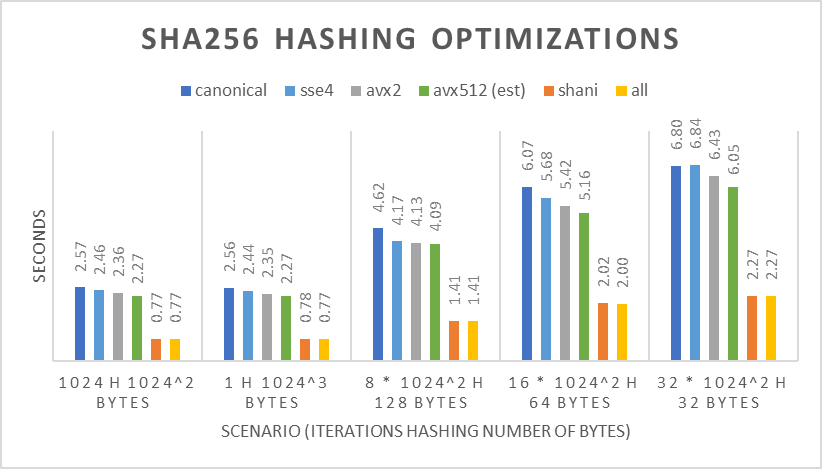
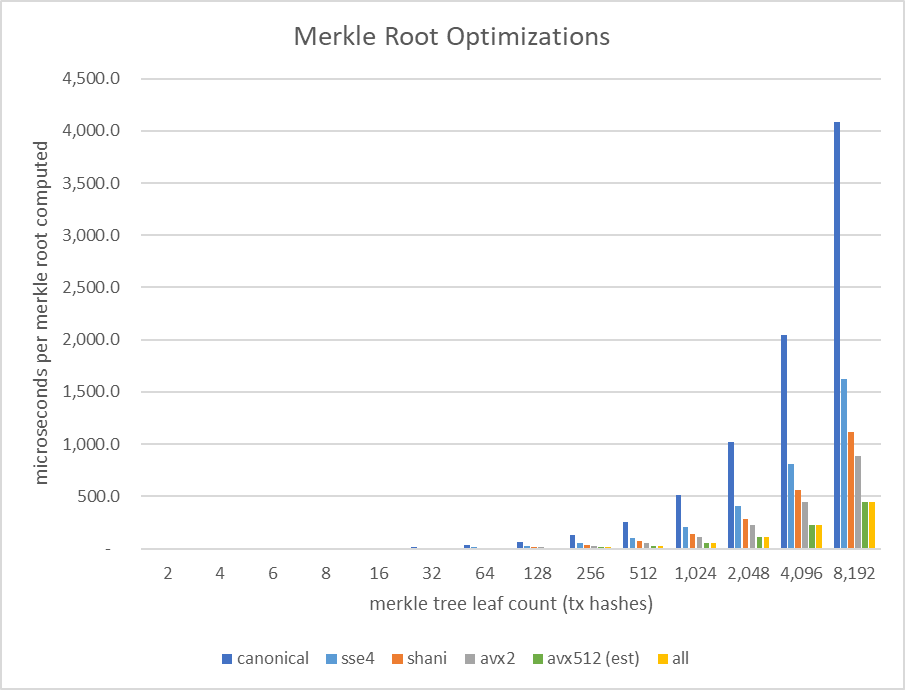
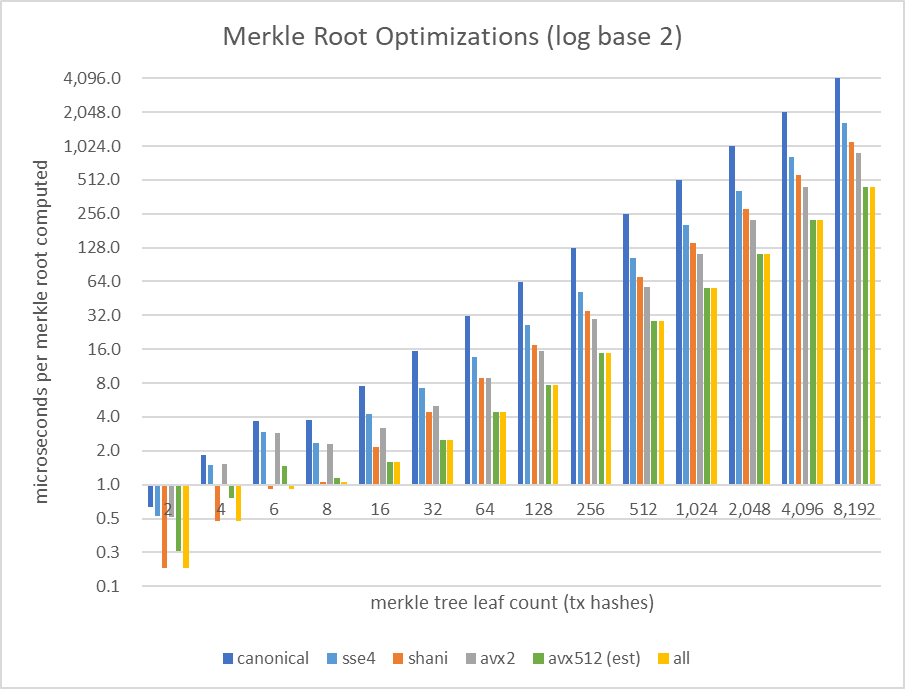
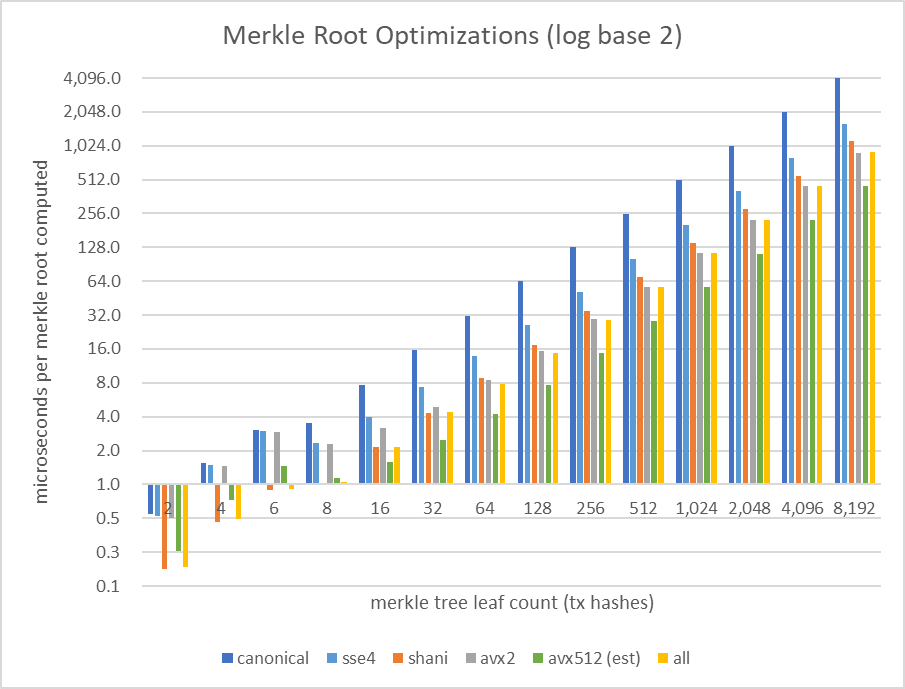
These are numbers drawn directly out of our libbitcoin-system performance tests. There are two distinct scenarios, simple sha256 hashes and sha256 Merkle root computations. I don't have a avx512 platform yet, but I have projected the results in both scenarios based on the trend between sse4 (4x32) and avx2 (8x32) to avx512 (16x32). The third plot is base2 logarithmic scale.
Interestingly these show that the canonical form takes .5 microsecond for each initial leaf hash of a Merkle tree to compute the root.
It's also clear that shani dominates regular hashing and vectorization avx2 and avx512 dominate Merkle tree hashing. However notice that at the low end of the Merkle hashing shani is dominant. That's because there aren't always enough lanes for beneficial vectorization. We vectorize at 4/8/16 lanes, but what this shows is that shani (in 1 lane) dominates sse4 (4 lane vectorization). That's about a 5% difference. So I'll prob be disabling 4 lane Merkle hashing.
🚀 1
evoskuil08:22
All of our Merkle hashing is now at about 20% of canonical and should drop to 10% with avx512 (as shown in the estimate/all). Not much more we can do with it now except get avx512 verified. We can also add the sha160 native optimizations - though that won't make much difference (one script opcode).
evoskuil08:35
I also just noticed that shani dominates for 32 Merkle blocks and below (Merkle trees with 64 tx hash leaves or less).
evoskuil08:59
I should also mention that vectorization optimizations are more significant on the maxi than the mini. On the maxi they range up to 30% time reduction. These numbers are all from the mini.
evoskuil10:17
This one's updated to reflect removal of sse4 and avx2 in ranges where shani dominates in the case where it is present. It also has "all" track with what's running/measured (so not avx512 yet).
evoskuil15:59
Just merged that work. There's more to do in terms of organization, but it's complete for now. Should be simple to integrate neon and sha160 as well at some point.
Tuesday, December 10, 2024
evoskuil04:46
This is with measured avx512 hashing. On this machine shani always beats sse4 and avx2 but avx512 always beats shani (until the set size precludes avx512 at less than 16 blocks). I also generated a baseline, which is about 20% more efficient than our unoptimized implementation (because we use buffer expansion). This however gives is a greater advantage (5-30%) in the vectorizations, primarily for non-Merkle.
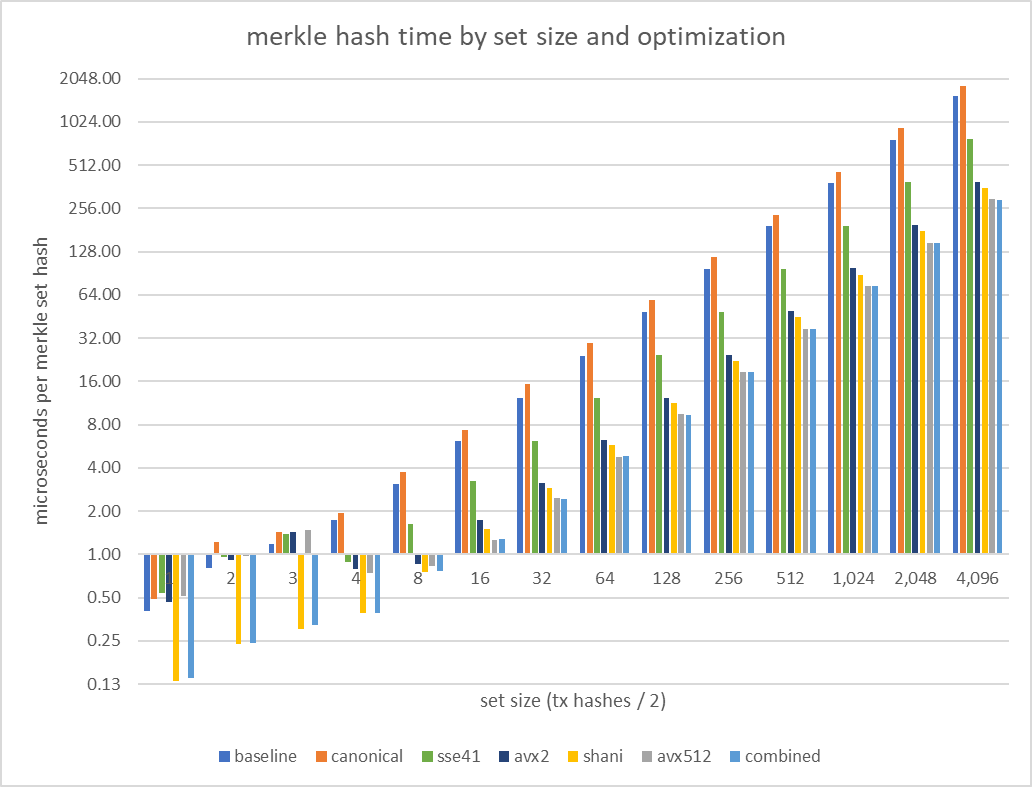
There's noise at the lower end because with a small number of blocks the vectorizations drop off and smaller optimizations (e.g. prescheduled pad caching, sigma vectorization) take over.
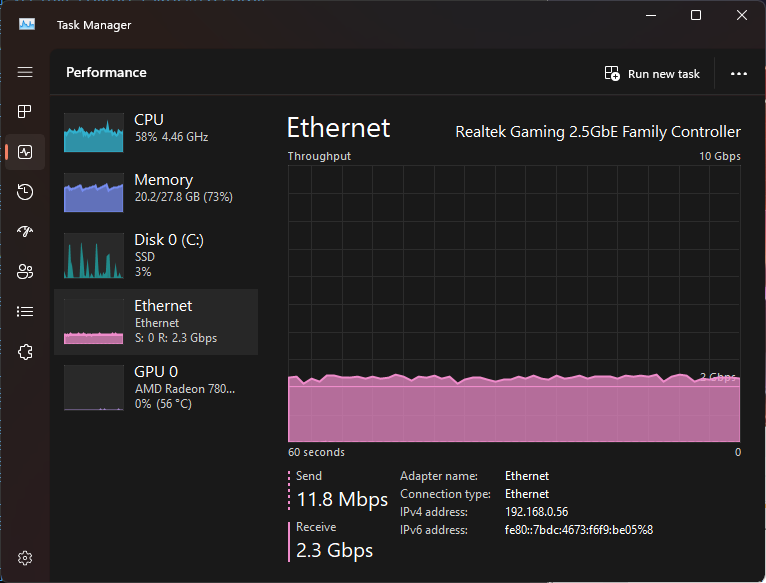
This is the new mini. Downloading at max bandwidth and now with 50% free CPU (8 dual cores), 30% free RAM (of 32GB), and a practically idle SSD (1TB).
Before the hashing updates the other mini, with a similar CPU but no avx512, would be fully maxed out at this point (30% sync complete).
Never maxed out CPU (averaged 50%), RAM or SSD - only NET. So now there's a lot more free time for concurrent validation.
(edited)There's still a few bones to pick over in sha optimization, but we're not gonna get much faster than this on my network. Just 5 minutes above the theoretical limit now.
👏 2
evoskuil18:52
The most recent mini run with shani completed download/validate in 9.8 hours. With this slightly faster processor running avx512 and some shani updates, the same is now tracking 18% faster and will complete at 8.1 hours.
10 replies · cguida, evoskuil · last Dec 11, 2024
evoskuil01:49
Right, though it excludes the final confirmation stage. On a low memory machine that can be expensive. I have a resolution for that. On high mem machines it's like 30 mins currently.
C
cguida01:50
Thinking of re-running the benchmark with 16GB instead of 32. Think that’ll take twice as long? haha
evoskuil01:51
It got a little faster due to axx512 availability, but mostly it reduced CPU utilization, from close to peak down to 50% for the full milestone run.
evoskuil01:52
Libbitcoin's weakness is paging. When memory gets low enough it can get costly. Above a certain level, it's inconsequential.
evoskuil01:54
All I know for sure right now is that at 32GB there is no more than 5 minutes cost to having less than infinite RAM.
👍 1
evoskuil22:08
If you want to repro the speed above you need a 2Gbps Internet connection (above measures out at 2.3), 8 3.x GHz dual cores preferably with native SHA and AVX512, 32 GB fast RAM and 1TB fast SSD. I've use PELADN 7840HS ($410) and a slightly slower PELADN 7735HS ($350). You need Windows (comes installed on these) and VS2022 community edition (free) [or I can send you a binary]. That's it.
well
I don't have the exact specs, and I'm on linux
but I just want to compare this with my attempts to sync bitcoin core, which are awful and sad and take weeks
😢 1
evoskuil22:11
More RAM is faster, with the above specs and more RAM you can probably get a couple minutes closer to the theoretical limit, and materially reduce CPU/SSD time.
Sure, if you get close it should be good. SSD and RAM speed are important, and RAM amount is important.
very bad
evoskuil22:13
I haven't tried that low, but it may be ok. Def need Windows because the Linux/macOS builds are not perf tuned yet. I've tried them out and they sync, but it's slow.
haha
so I'll come back when I have that
The initial store sizing is about 1/4 sized.
1 reply · cguida · last Dec 11, 2024
What's your network?

fiatjaf _22:15
I'll get a better SSD and come back, but still you should record a video or something like that
showing the record-fast times
let me check my network
ahahah, well, you can speed it up
1 reply · cguida · last Dec 11, 2024
C
cguida01:46
Delving Bitcoin
Recently Eric Voskuil shared a benchmark of doing IBD with Libbitcoin versus Bitcoin Core, showing that Libbitcoin could perform IBD 15x faster than Core with -assumevalid. Libbitcoin’s approach is very different from Bitcoin Core. This writeup intends to summarize how Libbitcoin functions for someone familiar with Bitcoin Core’s approach. This discusses the behaviour of upcoming, not yet released, version 4 of Libbitcoin. Libbitcoin is event-based. It will kick-off multiple asynchronous tasks...
fiatjaf _22:19
like a high level description of what magic data structures and disk layout you're using or something like that?
I would be very happy with 14h syncing, less bandwidth also means I use less RAM or not?
evoskuil22:20
Yeah, but it's not really consumable. The data structures description is pretty good, but that's not really what gets it done. It's a lot of big picture things.
fiatjaf _22:21
I heard bitcoin core can only be at maximum speed if the entire utxo set fit in memory, but that sounds unrealistic and an overkill
1 reply · evoskuil · last Dec 10, 2024
evoskuil22:56
Everything is faster while using RAM vs. disk, assuming the RAM is read/write faster than the disk. But Core's maximum speed would still limited by the order imposed UTXO store.
1 reply · evoskuil · last Dec 10, 2024
evoskuil23:06
This is just an implementation of in-memory arrays, contiguous blob storage, and hash maps of arrays and blob storage, with multimap interpretation. The headers and bodies are independently stored. And the whole thing is templatized for byte-level sizing of links. Otherwise there's not much to it.
(edited)evoskuil22:23
The code's a little longer than it used to be, just some denormalization for optimization purposes.
(edited)evoskuil22:56
replied to a thread: view
Everything is faster while using RAM vs. disk, assuming the RAM is read/write faster than the disk. But Core's maximum speed would still limited by the order imposed UTXO store.
evoskuil23:06
replied to a thread: view
This is just an implementation of in-memory arrays, contiguous blob storage, and hash maps of arrays and blob storage, with multimap interpretation. The headers and bodies are independently stored. And the whole thing is templatized for byte-level sizing of links. Otherwise there's not much to it.
(edited)Wednesday, December 11, 2024
evoskuil01:57
Downloading and validating. This is the CPU picture we want to see from start to finish. It only drops off the peg for two reasons. (1) to flush to disk [which can be eliminated entirely with sufficient RAM], and (2) to wait for the last blocks in the concurrency window [which can be entirely eliminated by opening the window to the full chain]. However to do #2 you really need to do #1.
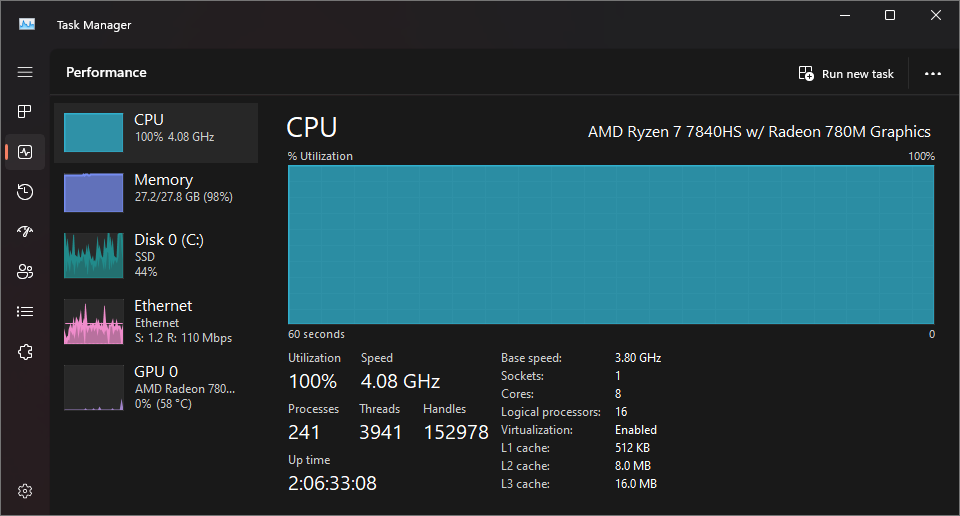
Correction, there is also (3) the need to ensure that preceding blocks are downloaded, which is why we use the concurrency window. However, the full download can complete in well under an hour, and with #1 the entire chain is essentially RAM cached and flushing is eliminated, so by allowing the download to complete quickly, the full validation can complete without CPU gaps.
The concurrent download/validate approach blends these two phases so as to use the free CPU time during download (if any) and to take advantage of memory locality on low RAM machines.
evoskuil02:47
The current download/validation run is at 67% the rate of my earlier one that took 9.8 hours. So looking like 6.6 hours!
(edited)evoskuil03:07
Speeding up a bit relative to the baseline. Tracking at 6.45 hours now. Getting close to the maxi download/validation run time (~5.5 hours last I checked).
evoskuil09:11
Completed in 7.8 hours, so 80% of previous. Not quite the 67% it started at, but pretty great. Download with concurrent validation to block 850k. Note that this is the avx512 mini ($421). On the big box (without shani or avx512) this takes 5.5 hours.
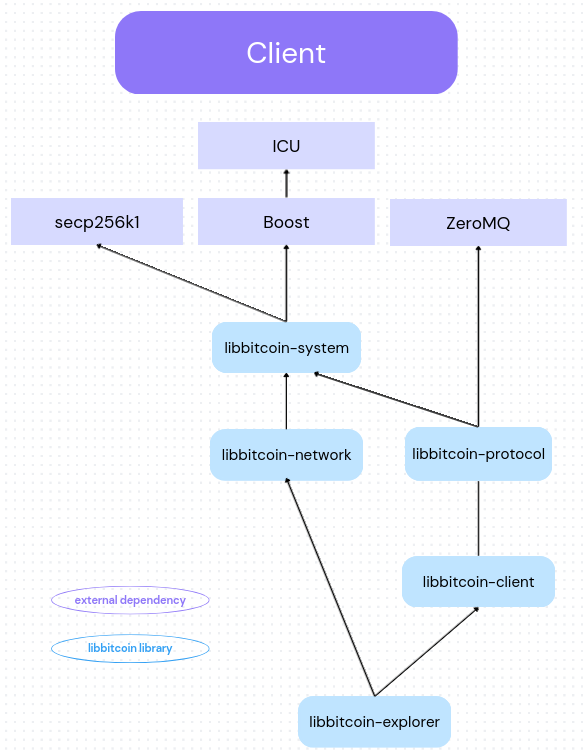
(edited)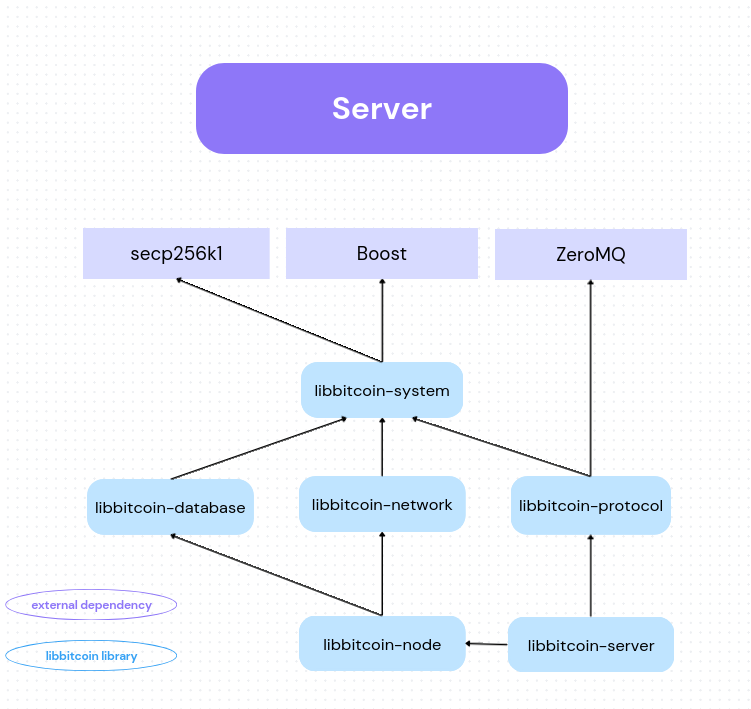
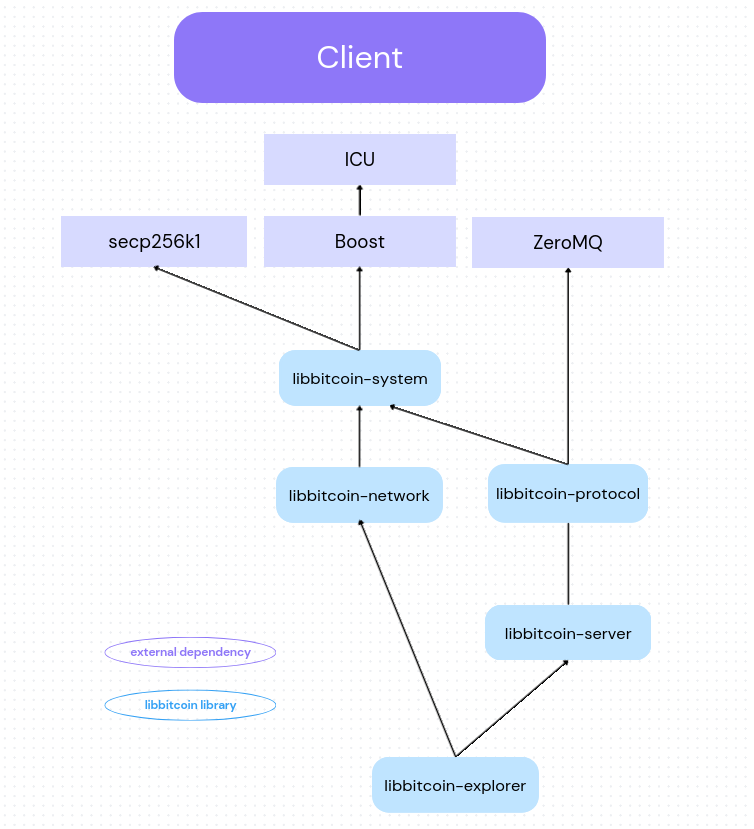
1 reply · Marnix · last Dec 11, 2024
Thursday, December 12, 2024
evoskuil04:47
Here's some hashing numbers. Not much context, but I'll just say it's pretty good.
D
David Chocholatý14:24
Hi all, long time no see. I apologize for my inactivity. I've been busier than I'd have liked. However, I've been trying to stay somewhat aware of what's been happening in libbitcoin. Currently, I'm finishing my studies and working on my master's thesis, which I'll complete next year. Based on that, I hope to have more time to contribute in the spring.
However, I would like to start contributing and get familiar with the codebase during the Christmas season. I want to ask about the current state of the Summer of Bitcoin's project. I saw some solution is being made by Shashank in a personal repository, but I am not sure about the status of this project in libbitcoin.
At the same time, are there other projects that need to be developed or work that needs to be done?
evoskuil14:58
Hi @David Chocholatý , welcome back. There's always work to be done. We meet here each Thursday at 4pm for general discussion if you'd like to start catching up. I'm not sure where the summer internship project ended up. It targeted a sqlite interface for the store for lower end machines. However we've been making good progress on performance tuning and this may become unnecessary.
Hi David. I'm not sure what is the status of
👍 1
D
David Chocholatý17:30
Thank you for the information. Good to know. Unfortunately, I won't be able to make today's meeting, but I'd like to join you next week. In the meantime, I will try to get more familiar with the system before the meeting.
👍🏻 1
Huddle with pmienk, evoskuil, Marnix · 89 min20:55
1 reply · Marnix · last Dec 12, 2024
Saturday, December 14, 2024
evoskuil01:59
Testing is complete with avx512, which modestly improves Merkle hashing at 16% of baseline vs. 18% from shani and materially over avx2 at 22% (and sse4 at 56%). Overall the shani/avx512 hash improvements over the past few weeks have reduced milestone sync time from 1 hour to 40 minutes and CPU utilization to 50% (from close to 100%). This savings combined with reduced hashing cost during validation has reduced sync/validation time from 9.8 hours to 7.8.
(edited)🚀 3
evoskuil21:49
On the big box sync/validation/confirmation is about 5.5 hours (without shani or avx512).
Today I added the template specializations and test cases to support
sha256-224, sha512-224, sha512-256, and sha512-384. As with all of our hashing, these support constexpr evaluation and CPU vectorization, as well as shani for the sha-256 variant (only the initialization vectors differ, and the final output is truncated to 224 bits).This was deferred work, bit I've been looking closely at using an output accumulator to accelerate the confirmation stage, and
sha512-256 is ideally suited for this task. It may be that basic sha256 may be more optimal, given shani but at least this way they can be compared.evoskuil22:01
I also ran a couple syncs with log messages compiled out. The log compilation options selectively remove all of the code for generating messages for a given level at runtime, which is a large amount - even if the messages are not output to the console or log they are still generated. But this removed all of that to the lowest level of logging. I've tested this before with the same result, but given the reduced sync time I decided to try it again. There was no noticeable difference in performance across the sync. So I remain confident that the logging system is very efficient. :)
Monday, December 16, 2024
evoskuil01:53
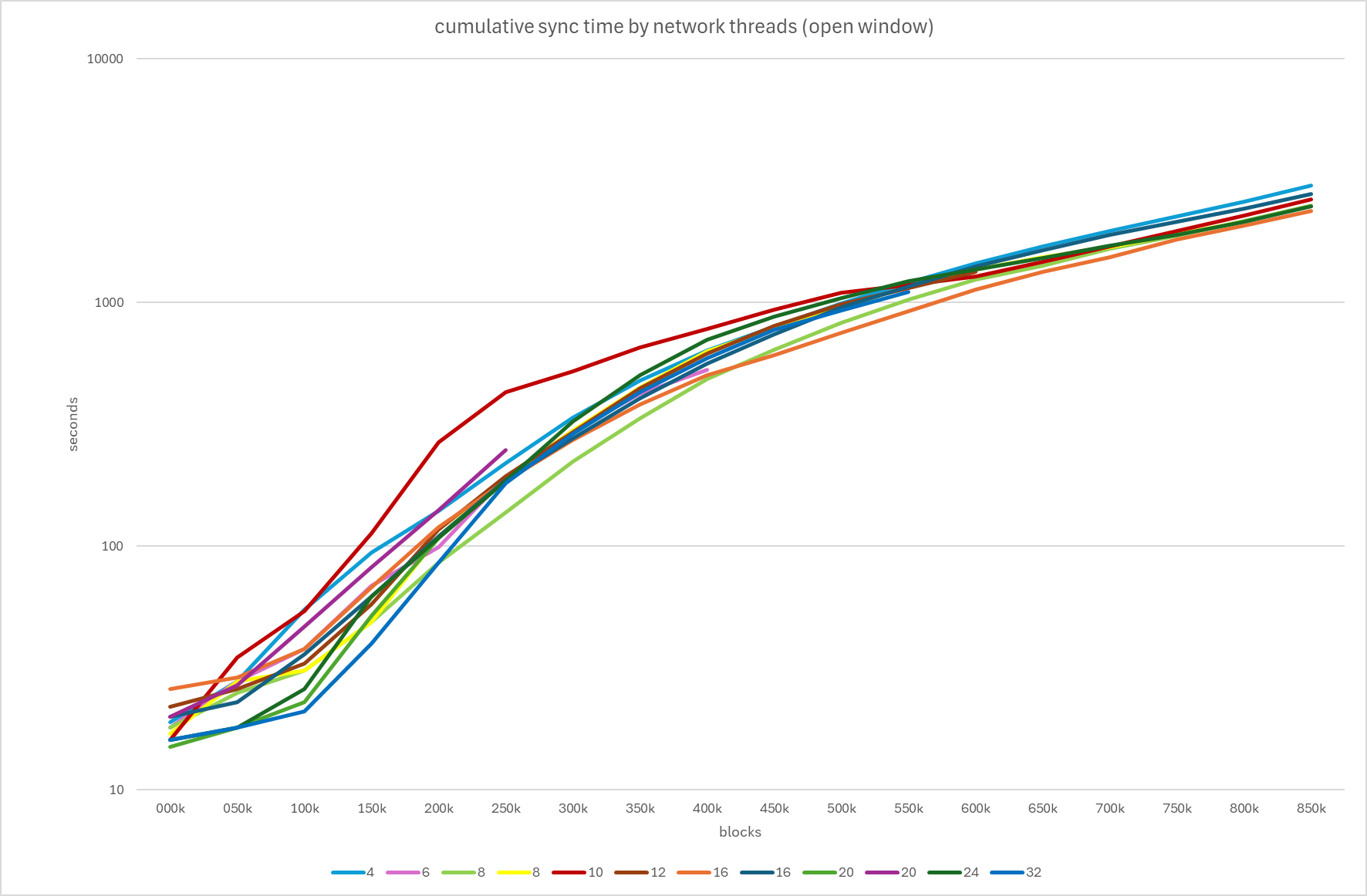
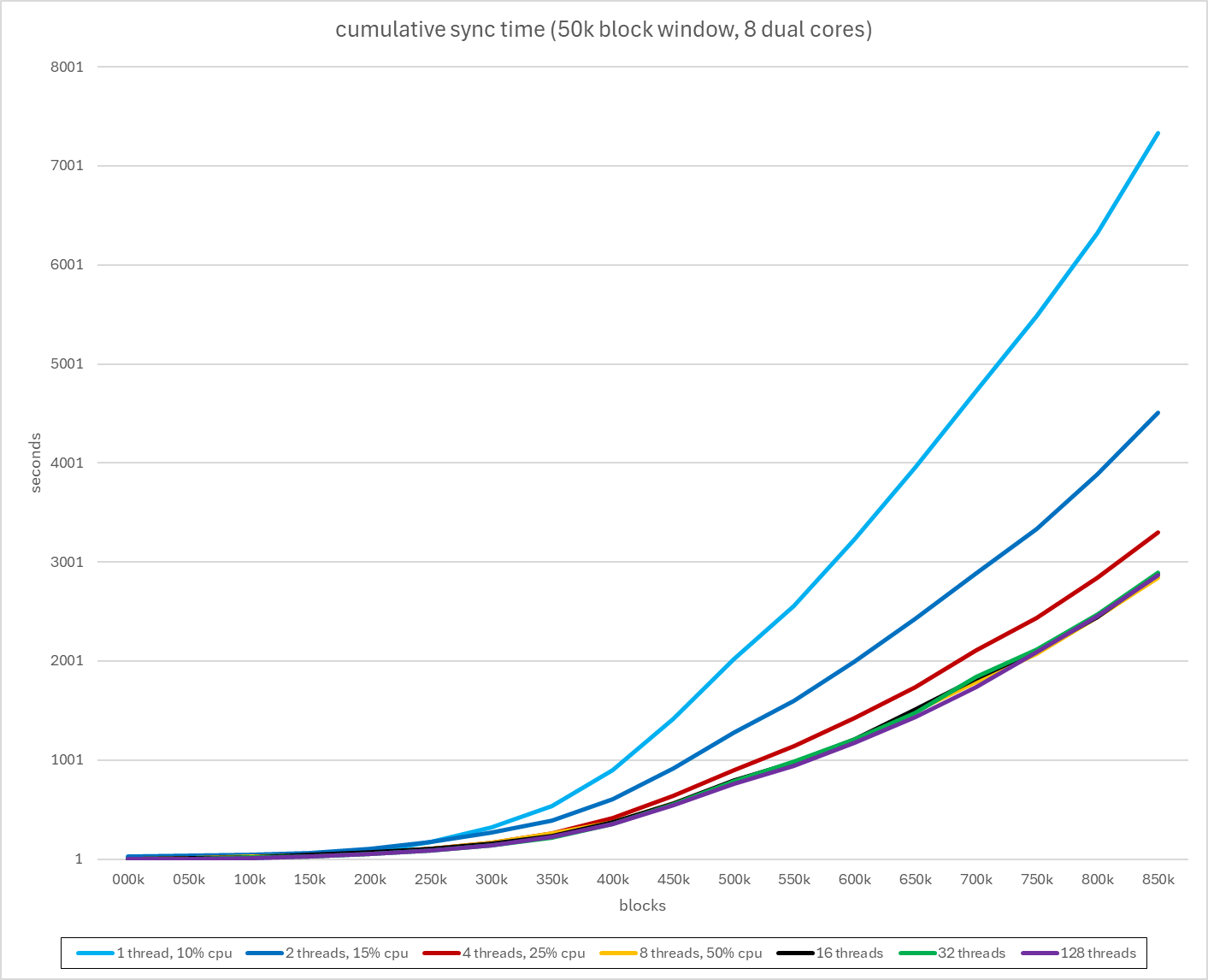
I ran these tests yesterday to see how configured thread count affects sync rate. Because this is all with an open (full) download window, the numbers are all over the place based on what blocks (large or small) download when.
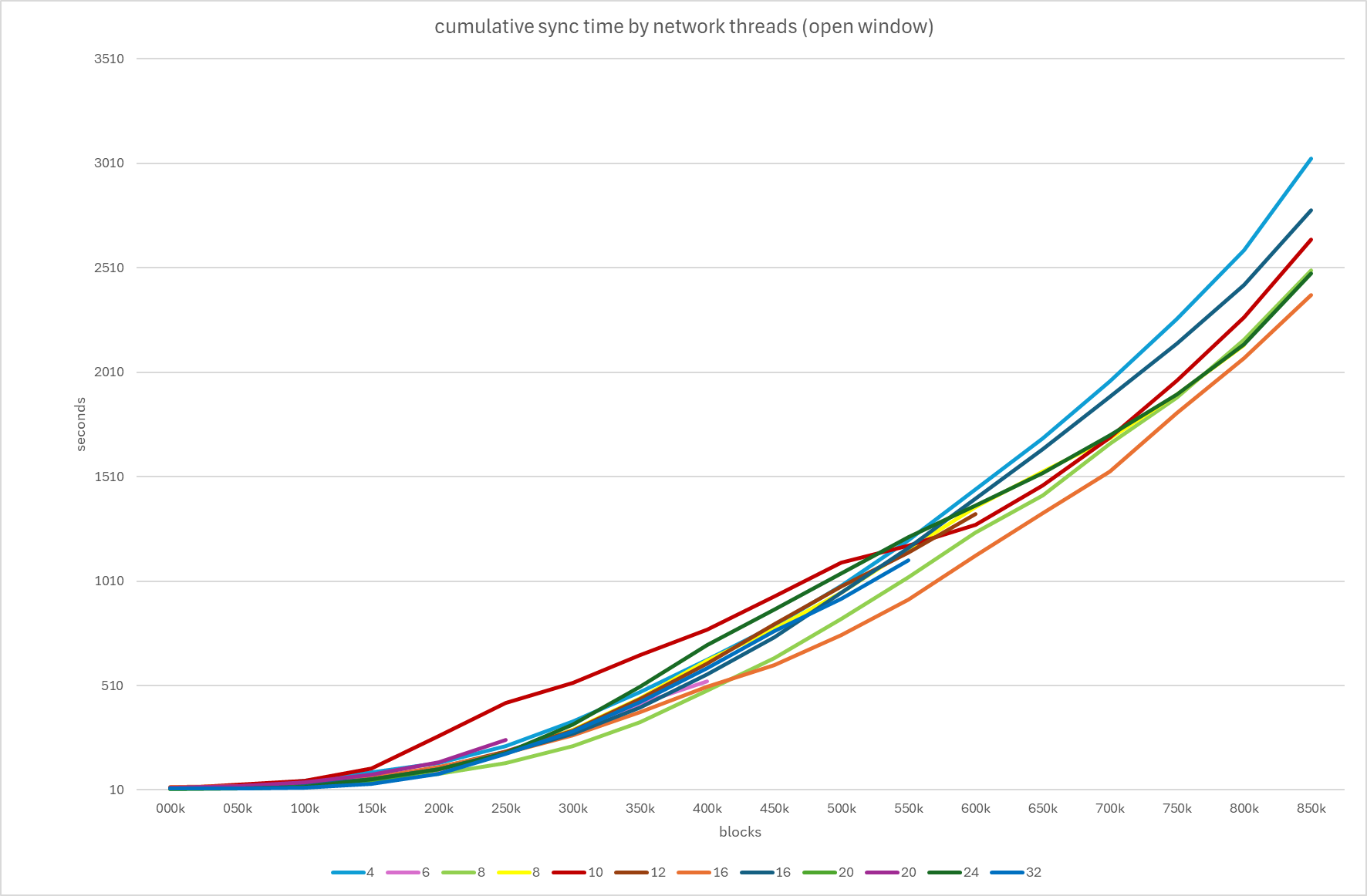
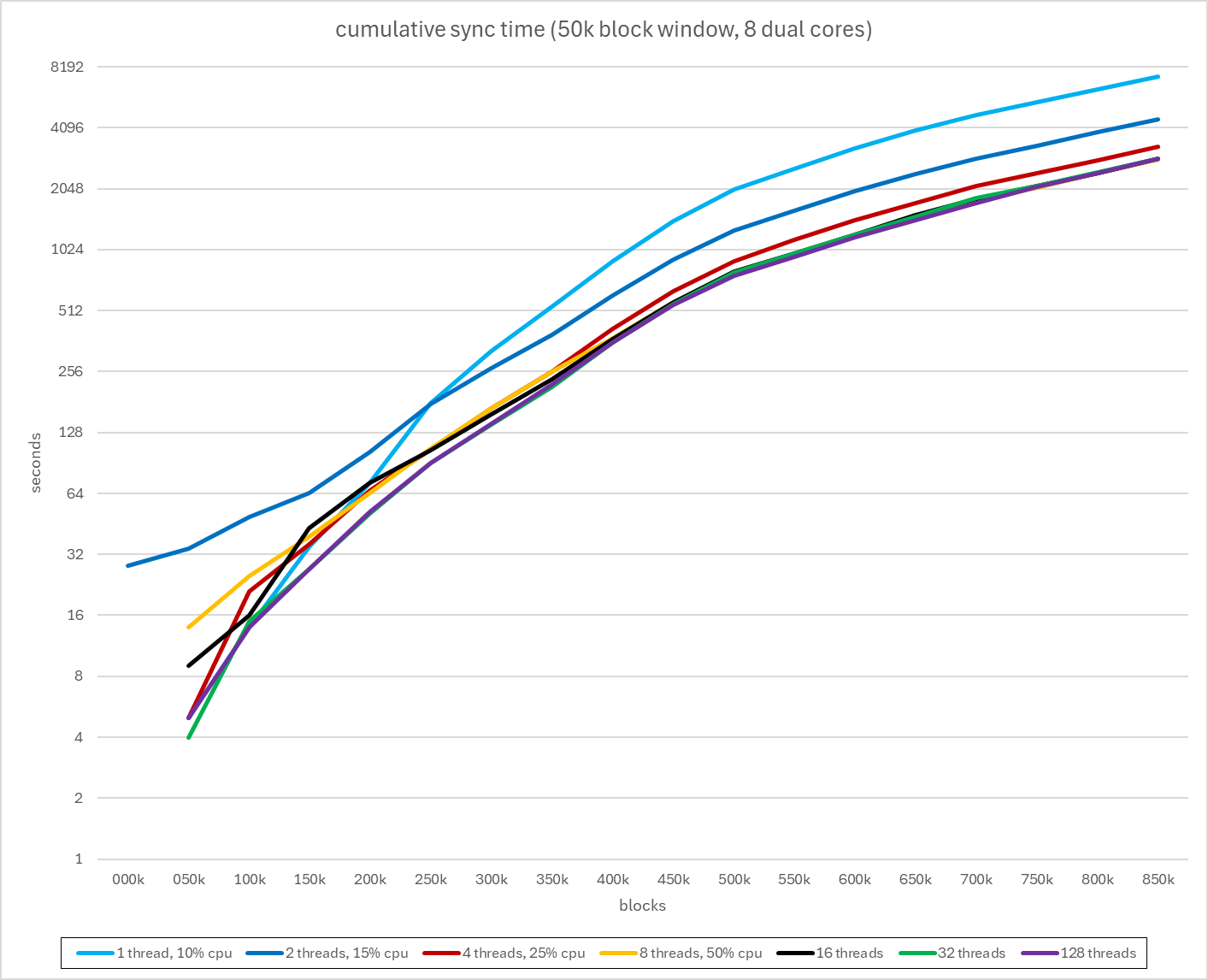
This is the same on a log10 scale. That opens up the low end so you can see it. Also note that these are not all zeroized at start. The first block time varies due to header sync time. In any case the rate is very consistent despite thread count because at the tail end it's almost all big blocks. IOW, sync rate appears to scale at a fairly constant multiple per thread.
2 replies · evoskuil · last Dec 16, 2024
evoskuil03:28
This observation isn't correct. The non-log graph shows that all thread counts tested are equally performant once the sync becomes network limited, that's why the lines parallel each other at the end of the graph. This is more obvious on the 50k window plot as is controls for downloaded block size. We actually need more threads when the blocks are smaller, so that we can process more concurrently in an effort to keep up with the network.
evoskuil03:32
We could say that the observation is correct up until the point where the node becomes network limited, but that's not the differentiation shown at the end of the plots above.
evoskuil01:57
I'll be running the same with a 50k window, which eliminates most of the variation by block size (and zeroizing the starts).
(edited)evoskuil04:53
This is a partial report of the windowed sync on the same machine as above. Even though the report is not complete, the interpretation is very clear.
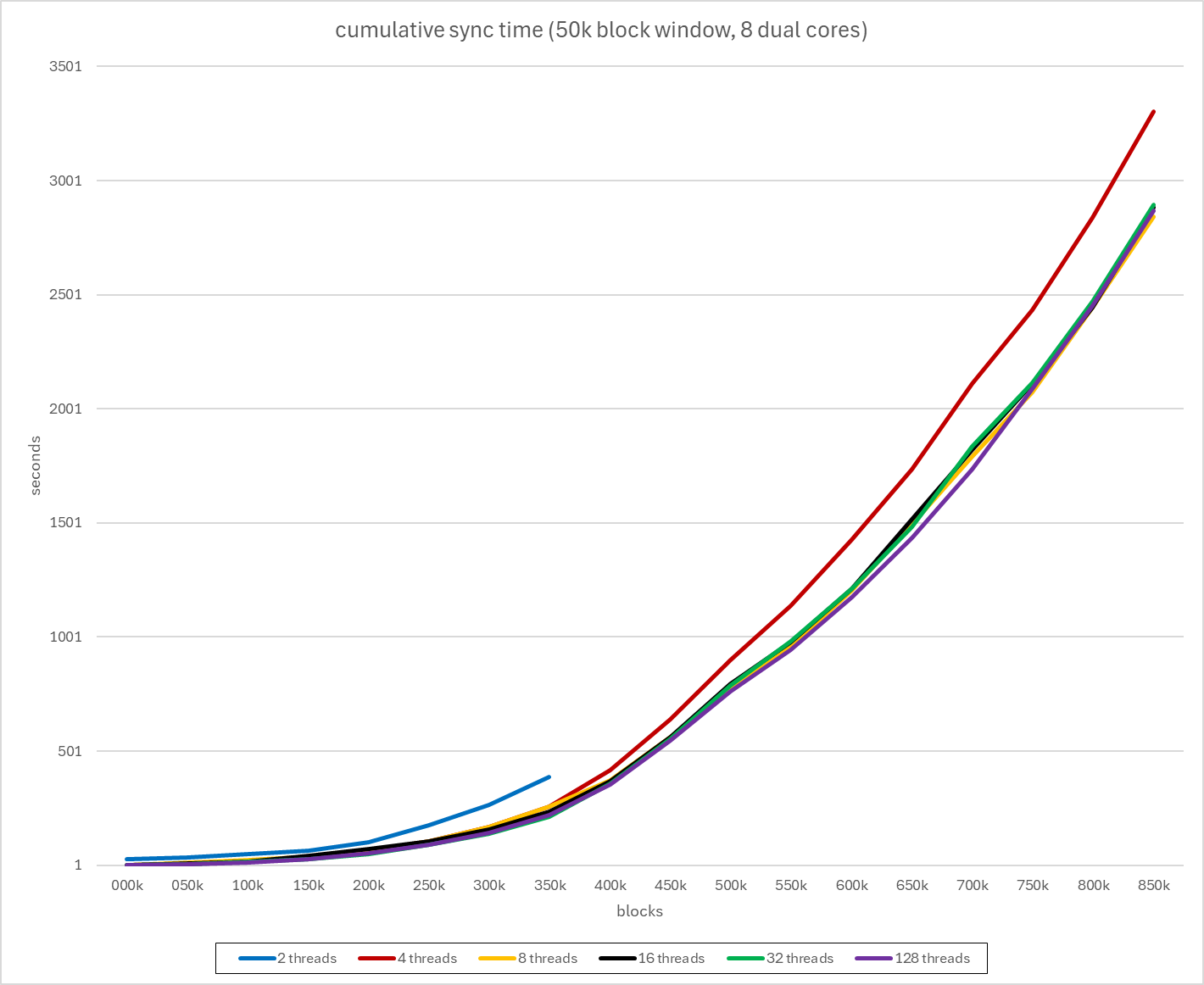
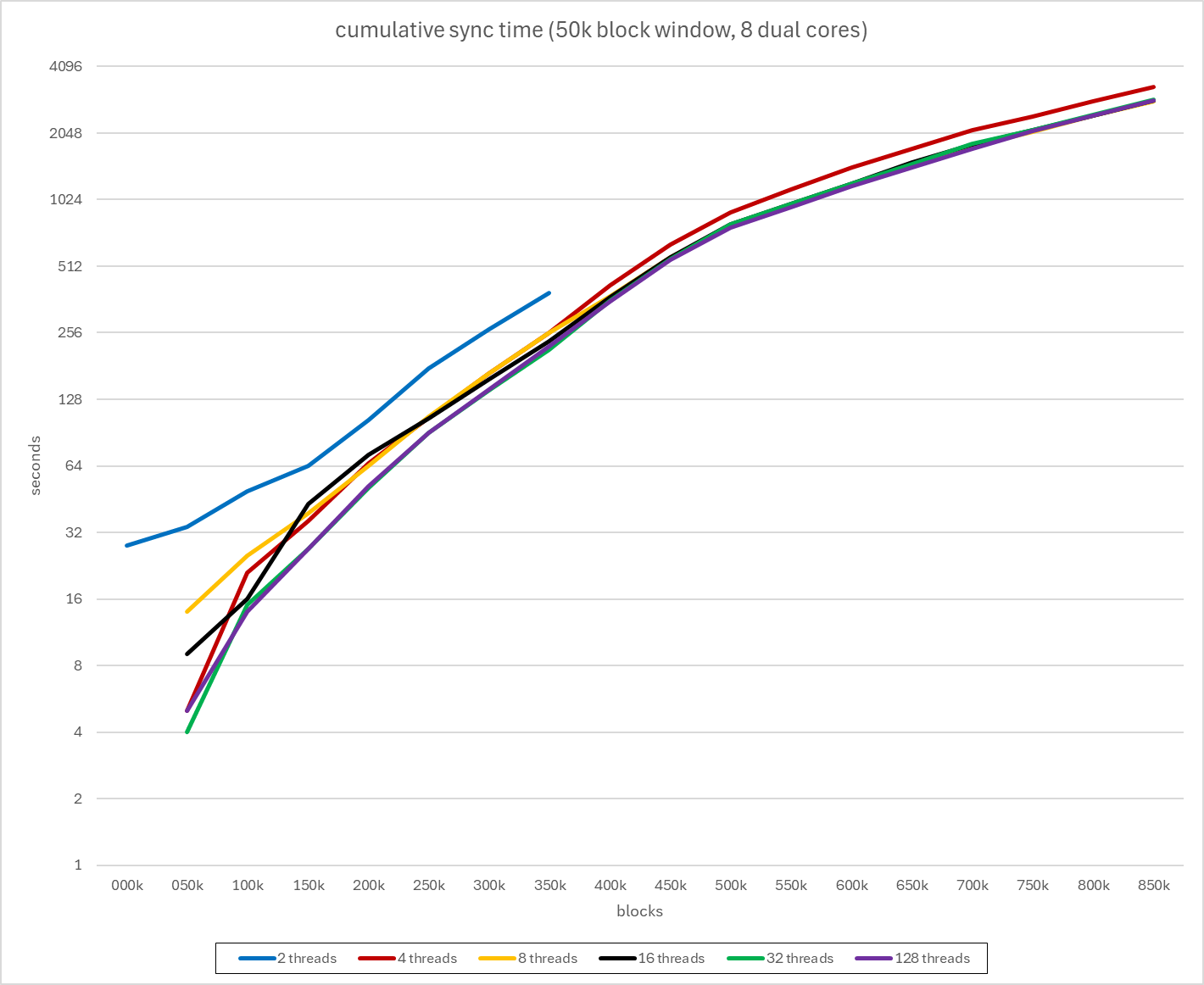
By block 400k or so the node becomes network bound. No addition of threads speeds (or slows) the sync beyond this point. However less than 8 threads (tested at 4 and 2) is insufficient to reach this limit. In that case speed is reduced by a constant about (i.e. scaling per thread).
Below block 400k at least 32 threads are required to keep up with the network. The first 100k blocks are less consistent because that happens in less than 30 seconds, and peer performance is measured in a 10 second window. So in the range we are starting up network connections and finding the fast peers. Even so, more threads clearly helps, up to 32.
Notice also that performance in the first 100k blocks doesn't really make a difference in overall performance, as long as there are at at least 8 threads. Completion rapidly converges around block 400. So 8 threads would be sufficient, but we want to get started as fast as possible as well. So for this 8 dual core machine on a 2.3Gbps network, we want at least 32 logical threads, which is twice the number of physical threads. And varying the number of threads in the pool really wouldn't make much difference, apart from some small amount of memory saved.
evoskuil05:51
The two thread run completed in 75 minutes, just 30 minutes longer than the full 8+ thread runs. That's 166% of the 8 thread run, with 25% as many useful threads. Even if 1 thread takes 90 minutes (200%) that is still an order of magnitude faster than Bitcoin Core on this machine - on just one thread. This is the power of the asynchronous architecture, which is enhanced by the lack of order. It's not just just the power of true concurrency.
Of course logging/eventing operates on a dedicated thread, as does console input, and the main process thread (waiting on a stop signal). But these are inconsequential to the sync process and spend most of their time idling.
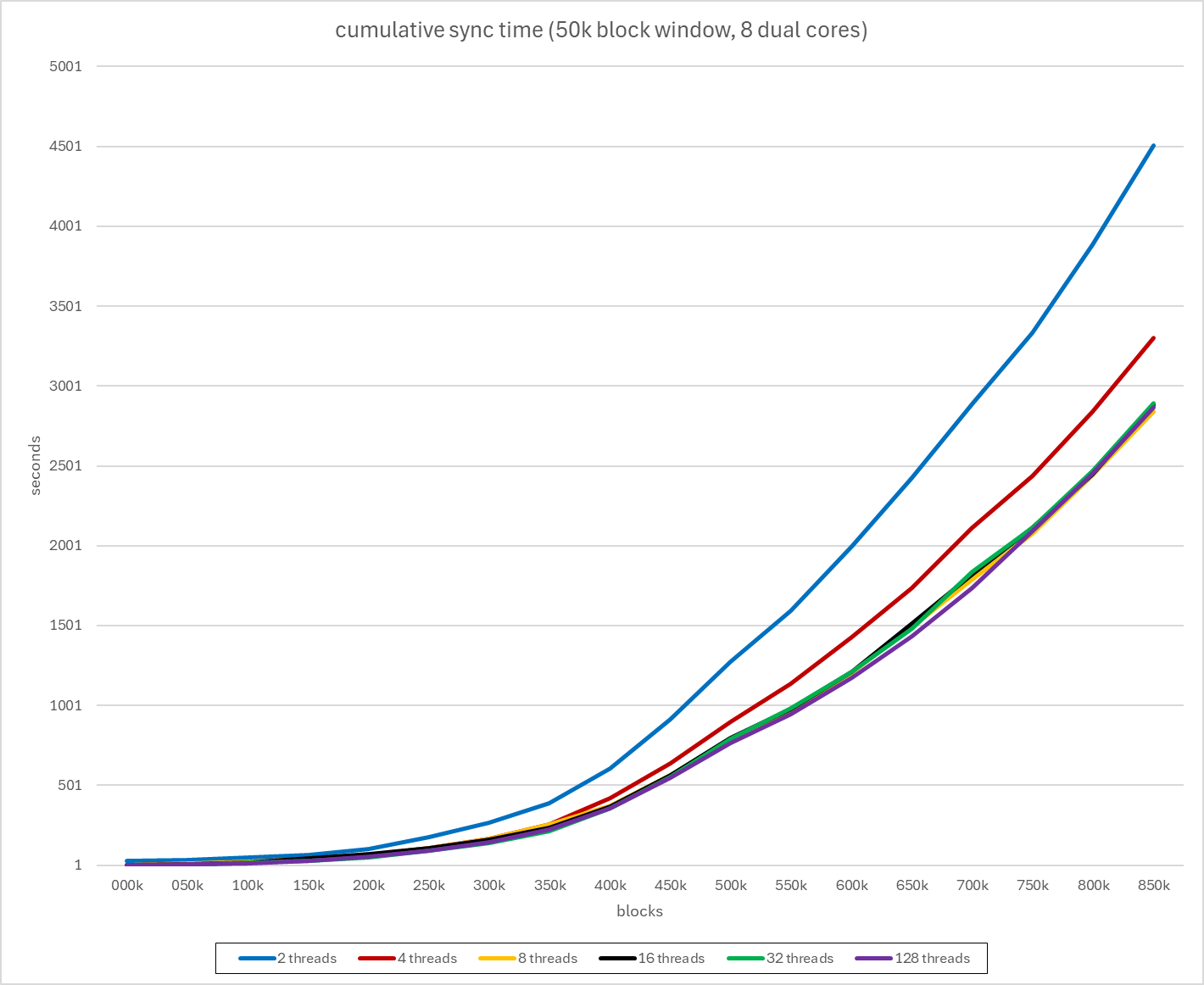
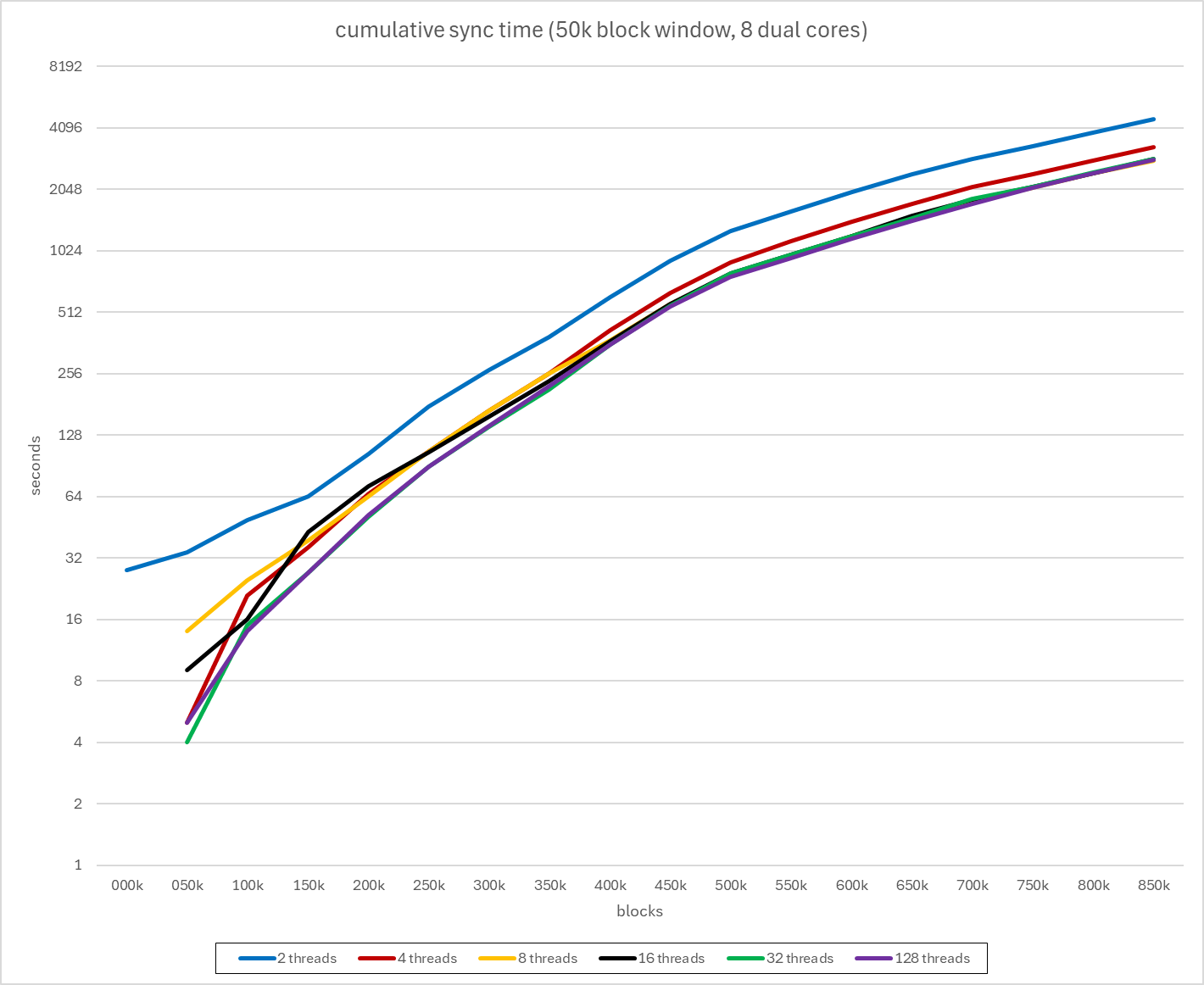
Note that all of these runs are operating with 100 configured peers.
Tuesday, December 17, 2024
Still, pretty damn impressive.
🔥 1
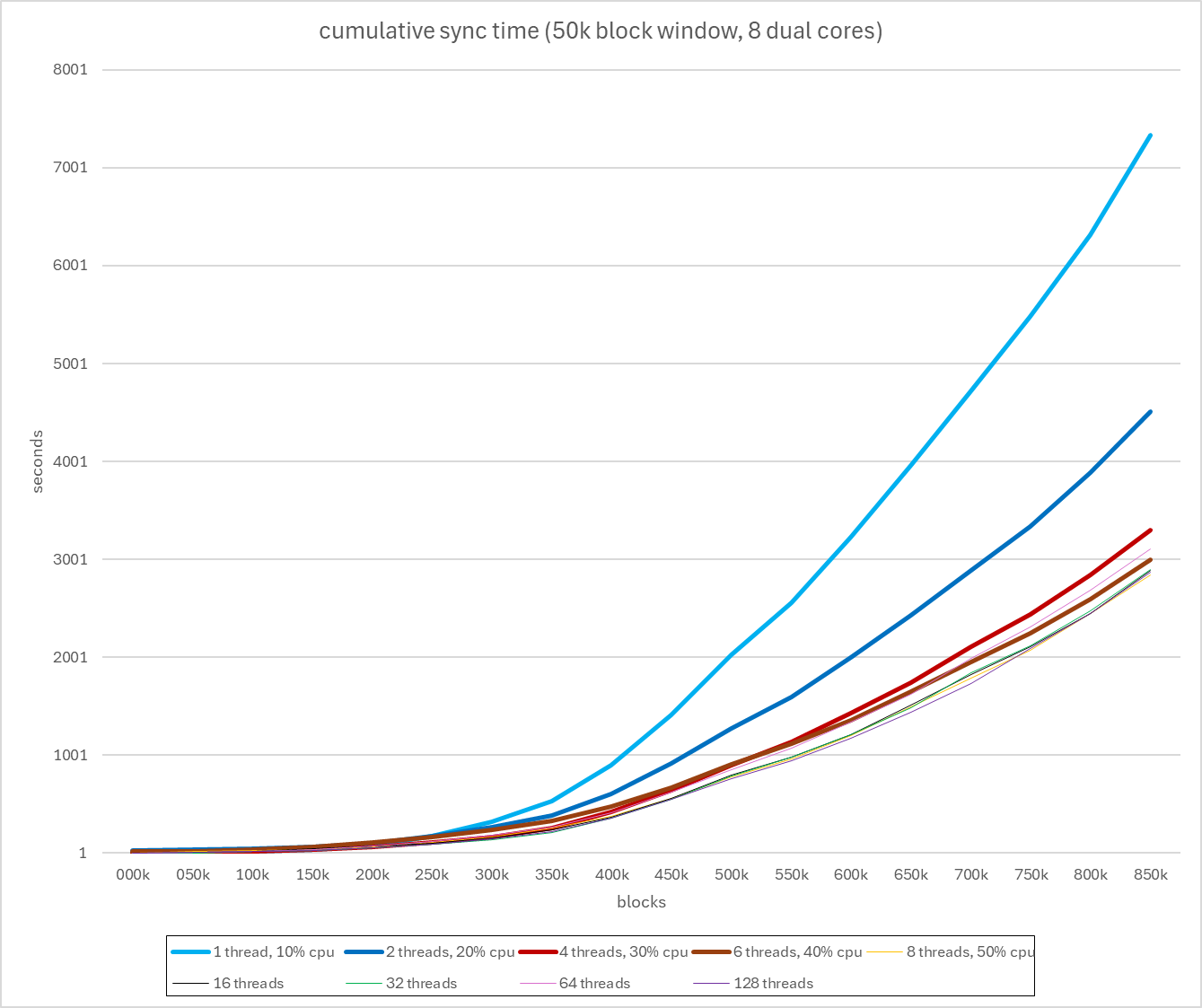
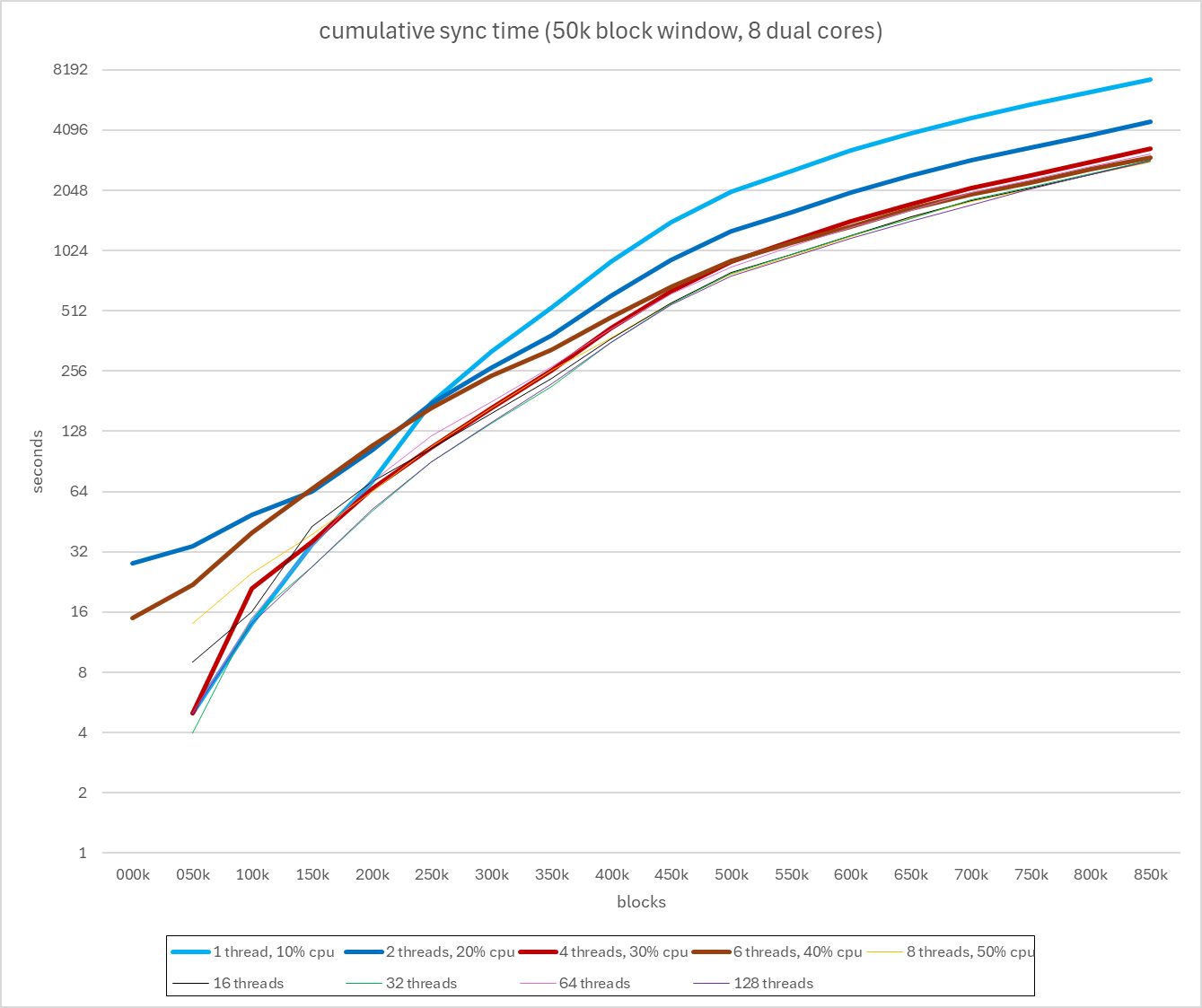
Complete report. I thinned out the lines for 8 threads and above, because they are right on top of each other.
Thursday, December 19, 2024
evoskuil01:20
In order to determine the benefit of calling
block.populate() prior to validation I performed these two competing validation runs against the same initial store state (fully downloaded to 850k using a 10 block concurrency window.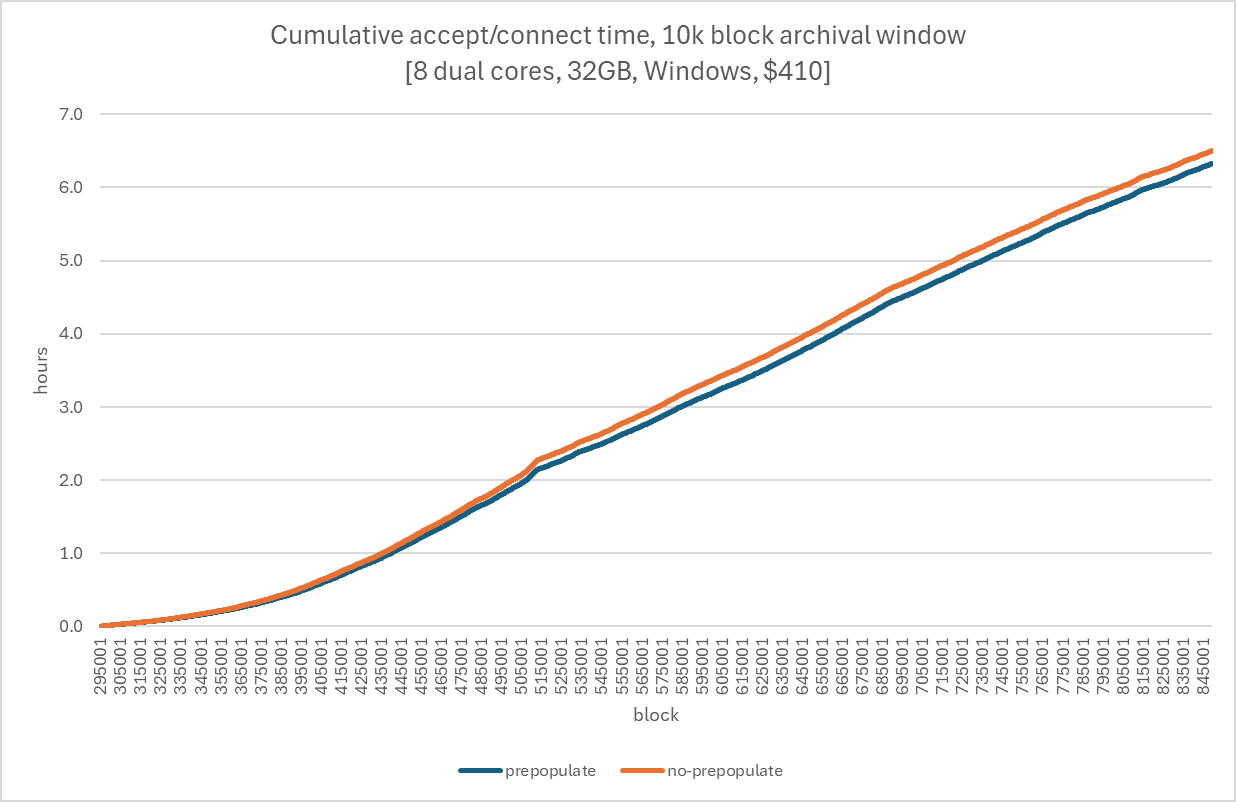
evoskuil01:27
block.prepopulate() obtains all previous outputs of tx inputs within the block that are present within the block and attaches them to the .prevout metadata field of spending input. Later when the query.populate(block) is called these prevouts are skipped. This saves database search and deserialization for some number of prevouts (I will trace that value per block, it would be interesting to know). The downside is that the iteration within the block is repeated. This turns out to be a worthwhile tradeoff, as the prepopulating run is 9.7 minutes faster, or 97.5% of the no-populate run. There is very little variation across runs since this is independent of the network. So while this is a small optimization, it is one line of code that turns out to be worthwhile. I'll disable the configuration option as there is no reason to disable the behavior now that it is verified.evoskuil01:46
This includes a plot of the same validation on the maxi machine, which has 4x as many cores and 8x as much RAM, but 50% of the mini RAM, SSD and CPU speed - and no shani (native sha256). The chain actually syncs faster on the mini, because of these differences, but the maxi wins validation (almost twice as fast) due to RAM and CPU capacity.
(edited)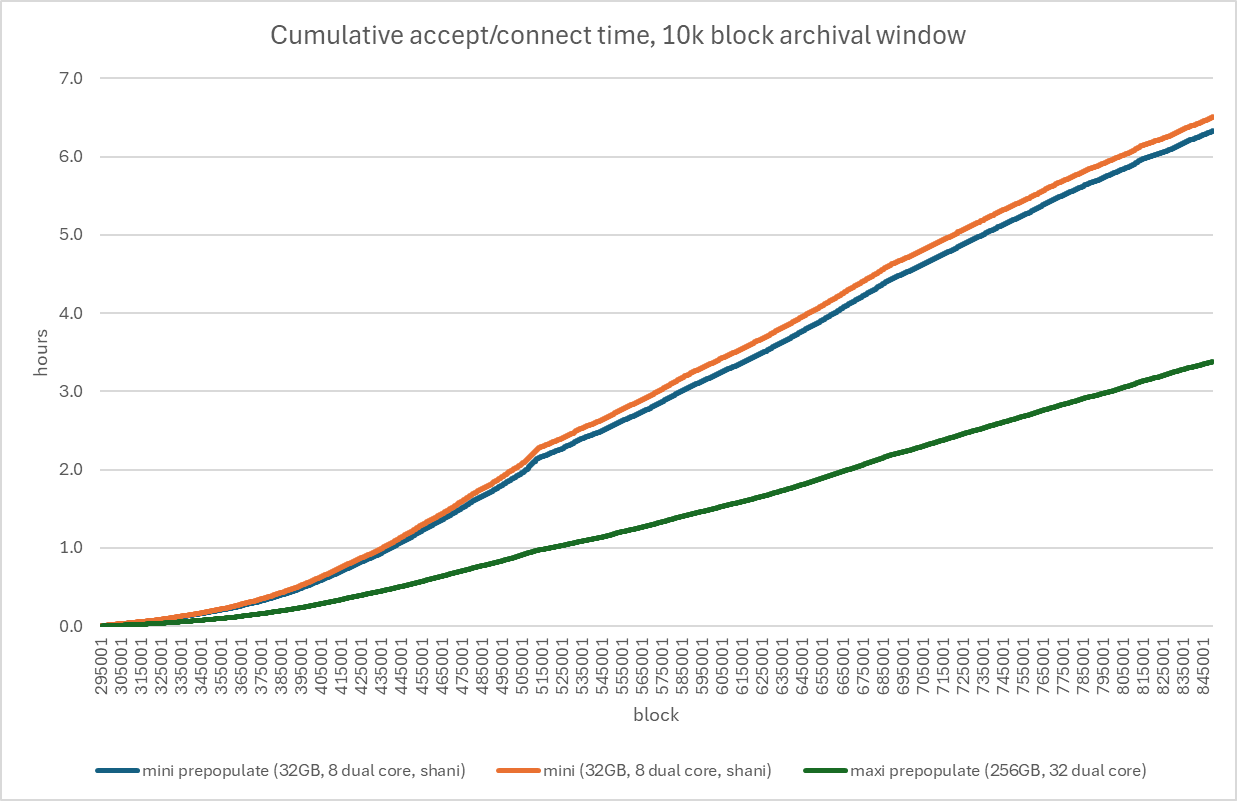
evoskuil01:54
It will be interesting to see how a maximal machine with shani fare in terms of validation. The large amount or RAM eliminates disk paging and the entire validation run is performed in RAM. All blocks and prevouts are deserialized from the store and validated. Validation is concurrent, with all blocks queued up for validation, invoked as soon as a thread becomes available. The block numbers in the plots above are block counts, not block heights. The first 295k blocks are checkpointed by consensus and complete within a few seconds.
evoskuil08:50
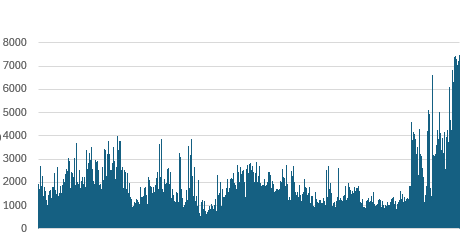
I tallied all inputs that spend prevouts in the same block, from block 295,001 to 850,000. This amounts to 238,539,676, or 9.1% of all inputs (from block zero).
(edited)evoskuil09:06
The distribution by block looks something like this, though this is not strongly ordered.
👀 1
Huddle with pmienk, Marnix, David Chocholatý · 27 min20:58
Thursday, December 26, 2024
Am I correct that it's in 10 minutes?
👍🏻 1
Huddle with pmienk, evoskuil, Marnix, cguida · 85 min21:11
2 replies · evoskuil · last Dec 26, 2024
Sunday, December 29, 2024
N
noah.312:04
Hi Eric. Where can I grab a current prebuilt binary of bn for Windows for testing?
bandwidth is 1Gbps
Is "maximum_height = 840,000" the only config setting to block sync at 840k? Thanks.
13 replies · evoskuil, noah.3 · last Dec 30, 2024
evoskuil22:12
I can send you one a little later. There’s lots of settings but you prob don’t need any apart from some seed nodes.
👍 1
evoskuil21:44
You will need to set some valid seed nodes or use a populated address cache file.
[network]
seed = ...
seed = ...
...